

Transitioning from high school writing to university-level composition can feel like entering a completely different world. In high school, many students find success by mastering the traditional five-paragraph essay: a neat introduction, three body paragraphs detailing isolated points, and a tidy conclusion that repeats the opening thesis. While this formula works well for basic essays, it quickly falls apart under the weight of higher education. University professors are not looking for a mechanical repetition of facts. Instead, they expect an active, analytical engagement with complex research, requiring a flexible framework that adapts to the arguments being made.
When a professor hands out an assignment sheet, the hidden key to success is almost always found in the grading criteria. Understanding how to decode these criteria is the first step toward building an effective structural foundation for your paper. If you learn how to structure a university essay correctly, you can transform your writing from a simple collection of summaries into a cohesive, persuasive argument. However, if you find yourself struggling to organize your thoughts or balance complex arguments, turning to a professional essay writing help service can provide the structural blueprint you need to align your writing with advanced academic standards.
Decoding the Evaluation Criteria
To meet university expectations, you must first understand what professors are actually looking for when they grade your paper. While specific rubrics vary across disciplines, almost all of them assess assignments based on four main core pillars:
- Argumentation and Thesis Strength: Is there a clear, arguable central claim that guides the entire paper?
- Evidence and Critical Synthesis: Does the writer source high-quality academic data and combine it effectively, or do they just list summaries of different articles?
- Structural Logic and Cohesion: Does the paper flow logically from one point to the next, with clear transitions between paragraphs?
- Academic Mechanics and Tone: Is the writing clear, formal, objective, and free of grammar errors?
The table below breaks down the major differences between standard writing habits and the advanced expectations of university grading rubrics:
| Grading Criteria | High School Standard | University Expectation |
| Thesis Focus | Descriptive and broad stating a known fact. | Analytical, arguable, and addresses a specific debate. |
| Evidence Usage | Dropping quotes into paragraphs without much explanation. | Synthesizing multiple sources to support a central claim. |
| Structural Flow | Strict five-paragraph format with predictable transitions. | Dynamic, multi-paragraph layout driven by logic. |
| Editing Priority | Fixing spelling and basic punctuation errors. | Improving structural flow, clarity, and overall argument hierarchy. |
Overcoming Structural Paralysis in the Planning Phase
The biggest challenge for many students happens before they even write their first sentence. Standing in front of a blank screen with a pile of open research tabs can easily cause structural paralysis, making it difficult to figure out how to organize a complex assignment. When you are buried under conflicting arguments and dense academic articles, finding a starting point feels overwhelming.
To break through this confusion, successful writers use smart pre-writing frameworks to organize their thoughts early on. Instead of trying to write a perfect draft on your first attempt, it helps to use helpful digital drafting tools during the planning phase. Working with an interactive paper typer can act as an excellent structural guide, helping you map out your initial ideas, test out paragraph layouts, and see how your arguments look on the page before you begin writing your final draft.
Using these initial outlining strategies allows you to shift your focus from simply worrying about word count to building a strong foundation for your paper. Once you have a clear plan in place, you can confidently turn your research notes into a well-structured academic argument.
Building a Strong Analytical Hierarchy
Once you move past the planning stage, the core of your essay depends on how well you organize your body paragraphs. A strong university paper uses a clear analytical hierarchy, meaning every single paragraph functions as a necessary building block for your main thesis.
A great way to keep your paragraphs focused is the MEAL framework, a popular writing method that ensures your analysis stays deep and structured:
- M – Main Idea: Begin every paragraph with a clear topic sentence that states the specific claim you will be exploring. This sentence should act as a mini-thesis for that paragraph.
- E – Evidence: Support your claim with solid research, data, or direct quotes from peer-reviewed academic sources.
- A – Analysis: Explain exactly why this evidence matters. This is the most crucial part of the paragraph where you interpret the data and explain how it supports your overarching argument.
- L – Link: Conclude the paragraph by linking your point back to your main thesis and smoothing the transition into the next section.
By following this approach, you can avoid the common mistake of letting long quotes do the talking for you. Your voice should remain the guiding force throughout the paper, using research to back up your unique perspective rather than letting sources take over your writing.
The Crucial Evolution From Proofreading to Developmental Editing
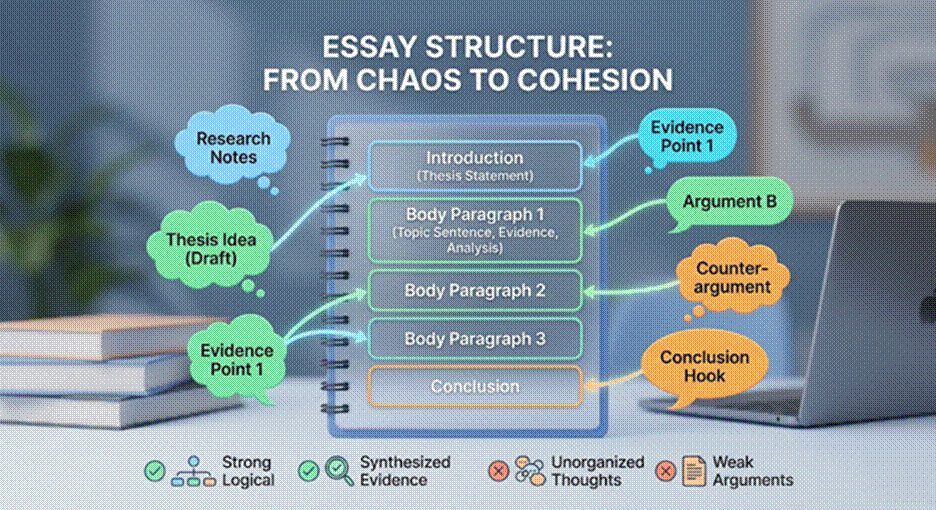
Many undergraduate students make the mistake of finishing a rough draft, running a quick spelling check, and submitting their paper immediately. However, basic proofreading only catches surface-level mistakes like typos, comma placement, or minor syntax issues. While clean grammar is important, it will not save a paper if the underlying argument is weak, unorganized, or confusing.
To secure top grades, you must focus on developmental editing. This advanced review process looks closely at the big picture of your paper, checking whether your arguments flow logically, your paragraphs transition smoothly, and your evidence actually backs up your thesis.
[Rough Draft Completed]
│
▼
[Developmental Editing] ──► Checks argument logic, structure, and flow.
│
▼
[Surface Proofreading] ──► Fixes minor grammar, typos, and commas.
│
▼
[Final Submission]
When handling high-stakes assignments or highly complex research topics, managing this level of deep revision on your own can be tough. Working with an academic service like MyAssignmentHelp gives students access to specialized guidance, offering an expert essay writing help service that focuses on structural editing, argument refinement, and making sure your writing perfectly aligns with your university grading criteria. Getting a professional look at your draft ensures your paper is evaluated on the quality of your ideas, rather than being dragged down by structural confusion.
Mastering Transitions and Rhetorical Cohesion
The final element of a great university paper is its overall cohesion. Your essay should read like a continuous, connected conversation rather than a disorganized list of random points. To achieve this flow, you need to master the art of paragraph transitions.
Instead of relying on basic transition words like furthermore, in addition, or consequently, try using conceptual transitions that connect the actual ideas between paragraphs. For instance, if your previous paragraph discussed the economic benefits of a policy, your next paragraph can start by looking at its social downsides: “While the economic advantages of this policy are clear, its long-term social consequences require an equally careful analysis.” This approach reminds your reader of where your argument has been while setting up exactly where it is going next, creating a professional narrative flow.
Frequently Asked Questions
What is the ideal length for a university essay paragraph?
On average, university paragraphs should run between 150 and 250 words. A paragraph needs to be long enough to fully introduce, explain, and analyze a single point, but short enough to keep your reader from losing track of the main idea.
How do I know if my essay has a strong thesis statement?
A strong thesis statement must be arguable, specific, and clear. If your thesis is something that everyone already agrees with, it is a descriptive statement rather than an analytical claim. Test your thesis by asking if someone could reasonably argue the opposite point.
What is the main difference between proofreading and editing?
Proofreading focuses purely on surface-level errors like spelling, grammar mistakes, and punctuation. Editing goes much deeper, looking closely at your overall structure, paragraph organization, argument clarity, and how well you use your evidence.
How can I make my writing sound more objective and formal?
To maintain a formal tone, avoid using personal pronouns like I, me, or my unless your assignment instructions explicitly ask for them. Stick to third-person perspectives and focus your sentences on the evidence and arguments themselves, rather than your personal feelings.
About The Author
Hi, I’m Ruby Walker, an academic consultant and digital content strategist at MyAssignmentHelp. With years of experience helping undergraduate and postgraduate students navigate complex academic frameworks, I specialize in breaking down advanced research methodologies and essay structures into practical, actionable