
Learning grammar rules for English can feel overwhelming at first. Many learners struggle because grammar is often taught in a complicated way. But the truth is, you don’t need to memorize hundreds of rules to communicate effectively.
What you really need is a clear understanding of how sentences work, along with practical examples you can use in real life.
This guide will help you build that understanding step by step-from basic sentence structure to more advanced concepts-so you can speak and write English with confidence.
What Are Grammar Rules?
Grammar rules are the guidelines that control how words are used together in a language. They help us form meaningful sentences and avoid confusion.
Without grammar:
- Sentences would be unclear
- Communication would break down
- Meaning could easily be misunderstood
Think of grammar as the structure behind language-like a framework that keeps everything organized.
Why Grammar Matters in Real Life
Many learners ask, “Do I really need grammar?”
The answer is yes-but not in the way you might think.
Grammar helps you:
- Speak clearly in conversations
- Write professional emails
- Avoid embarrassing mistakes
- Express ideas accurately
For example:
- “I no understand your point”
- “I don’t understand your point”
The second sentence sounds more natural and professional.
The Foundation: Basic Sentence Structure
Every English sentence follows a simple pattern:
Subject + Verb + Object (SVO)
This is the most important rule in English grammar.
Examples:
- She reads books
- They play football
- Ahmed eats lunch
Once you understand this structure, everything else becomes easier.
Essential Grammar Rules for English
Let’s explore the most important rules you need to know.
Subject-Verb Agreement
The subject and verb must match in number.
Examples:
- He works
- He work
- They work
- They works
This rule is simple but very important for correct sentences.
Use Complete Sentences
A complete sentence must have:
- A subject
- A verb
- A complete idea
Examples:
- Running in the park
- She is running in the park
Incomplete sentences can confuse your reader.
Be Consistent with Tenses
Tense shows time (past, present, future). You should not mix tenses in one sentence.
Examples:
- She went to the store and buys milk
- She went to the store and bought milk
Consistency makes your writing clear.
Use Articles Correctly (a, an, the)
Articles are small words, but they are very important.
- a → general (a book)
- an → before vowel sound (an apple)
- the → specific (the book on the table)
Examples:
- I saw a dog
- I saw the dog that bit me
Correct Word Order
English uses a fixed word order.
Statement:
- She is happy
- Question:
- Is she happy?
Changing word order incorrectly can change meaning.
Use Pronouns Properly
Pronouns replace nouns to avoid repetition.
Example:
- Ali has Ali’s car
- Ali has his car
Pronouns must match number and gender.
Use Prepositions Carefully
Prepositions show relationships like time and place.
Examples:
- in the room
- on the table
- at night
Wrong prepositions can change meaning completely.
Use Conjunctions to Connect Ideas
Conjunctions join words and sentences.
Common conjunctions:
- and
- but
- because
- although
Example:
I was tired, but I finished my work
Follow Capitalization Rules
Capitalize:
- First word of a sentence
- Names (people, places)
- Languages and nationalities
Examples:
- She lives in Pakistan
- He speaks English
Use Punctuation Correctly
Punctuation makes writing easier to understand.
- Period (.) → end of statement
- Comma (,) → pause or separation
- Question mark (?) → questions
Example:
- Let’s eat, grandma
- Let’s eat grandma (very different meaning!)
Intermediate Grammar Concepts
Once you understand the basics, you can move to the next level.
Adjective Order
When using multiple adjectives, follow this order:
Opinion + Size + Age + Color + Noun
Example:
- A beautiful small old house
This makes your sentences sound natural.
Active and Passive Voice
Active Voice:
- The teacher explains the lesson
Passive Voice:
- The lesson is explained by the teacher
Active voice is clearer and more direct.
Clauses and Phrases
- Clause = has subject and verb
- Phrase = group of words without full meaning
Example:
- When she arrived (clause)
- In the morning (phrase)
Common Grammar Mistakes to Avoid
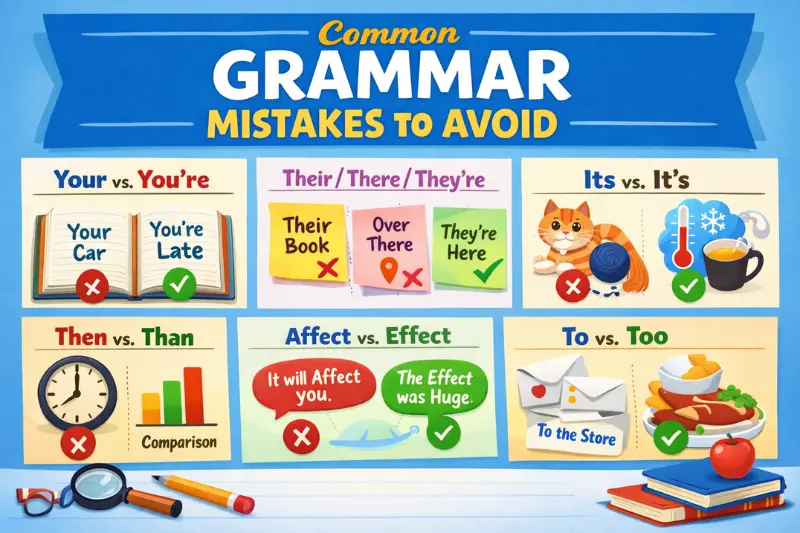
Even advanced learners make these mistakes.
Confusing Similar Words
- your / you’re
- its / it’s
- there / their / they’re
These mistakes are very common but easy to fix with practice.
Run-on Sentences
Run-on sentences combine ideas incorrectly.
Example:
- I like coffee I drink it daily
- I like coffee. I drink it daily
Sentence Fragments
Fragments are incomplete sentences.
Example:
- Because I was tired
- I slept because I was tired
Misplaced Modifiers
Modifiers should be close to the word they describe.
Example:
- He sat on the chair wearing a hat
- Wearing a hat, he sat on the chair
Practical Grammar for Real-Life Situations
This is where most competitors fail-you need real usage examples.
Everyday Speaking
- She don’t like tea
- She doesn’t like tea
WhatsApp Messages
- I am go market yesterday
- I went to the market yesterday
Professional Emails
- I want job
- I would like to apply for a job
Job Interviews
- I am work in company
- I work in a company
Quick Grammar Cheat Sheet
Here’s a quick revision:
- Sentence = Subject + Verb + Object
- Match subject and verb
- Don’t mix tenses
- Use a/an for general, the for specific
- Use punctuation properly
Save this for daily practice.
How to Improve Your English Grammar Fast
Improving grammar doesn’t require years-it requires consistency.
Tips:
- Practice daily (10–15 minutes)
- Read simple English content
- Write short sentences
- Learn from mistakes
- Use grammar tools
Do You Need to Learn All Grammar Rules?
No.
You only need to learn:
- Basic structure
- Common rules
- Frequent mistakes
Fluency comes from practice, not perfection.
FAQs About Grammar Rules for English (Short Answers)
What are grammar rules for English?
Grammar rules are guidelines that help you form correct and meaningful sentences.
Why are grammar rules important?
They make your communication clear and easy to understand.
What is the basic sentence structure?
Subject + Verb + Object (SVO).
What is subject-verb agreement?
The subject and verb must match in number (singular or plural).
What are the most common grammar mistakes?
Your/you’re, its/it’s, wrong tenses, and run-on sentences.
How can I improve my grammar fast?
Practice daily, read English, and learn from mistakes.
Do I need to learn all grammar rules?
No, focus on basic and commonly used rules.
What is a complete sentence?
A sentence with a subject, verb, and complete idea.
What are articles in English?
Words like a, an, and the used before nouns.
What is the easiest way to learn grammar?
Learn with examples and use grammar in real life.
Conclusion
Learning grammar rules for English doesn’t have to be difficult. You don’t need to memorize every rule-instead, focus on understanding the basics and using them in real-life situations.
Start with simple concepts like sentence structure, subject-verb agreement, and correct tenses. As you practice daily, your confidence will grow, and using proper grammar will become natural.
Remember, improving your grammar is a journey. Stay consistent, learn from your mistakes, and keep practicing. Over time, you’ll be able to communicate clearly and effectively in both speaking and writing.