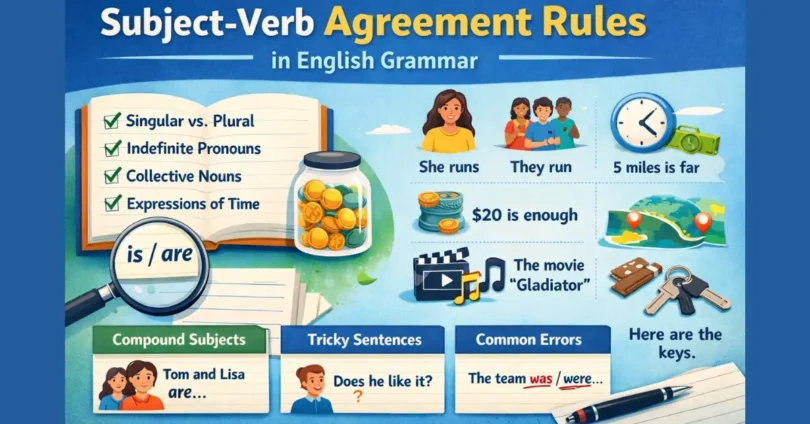

Understanding subject verb agreement rules English grammar is essential for writing correct and clear sentences. Whether you’re a student, writer, or professional, mastering these rules ensures your sentences are grammatically accurate. This guide explains everything in simple language, with examples, tips, and exercises.
Table of Contents
What Is Subject-Verb Agreement?
Subject-verb agreement means that the subject and the verb in a sentence must match in number and person.
- Singular subjects take singular verbs.
- Plural subjects take plural verbs.
Example:
- The cat runs fast. (Singular)
- The cats run fast. (Plural)
Think of it as a “teamwork rule”: the subject and the verb must work together.
Why Subject-Verb Agreement Matters
Correct subject-verb agreement:
- Makes sentences clear and professional.
- Prevents confusion for readers.
- Helps in academic writing, emails, and reports.
Incorrect example:
- The group of students is going to the library. (Correct)
- The group of students are going to the library. (Incorrect unless referring to individuals acting separately)
Basic Rules of Subject-Verb Agreement
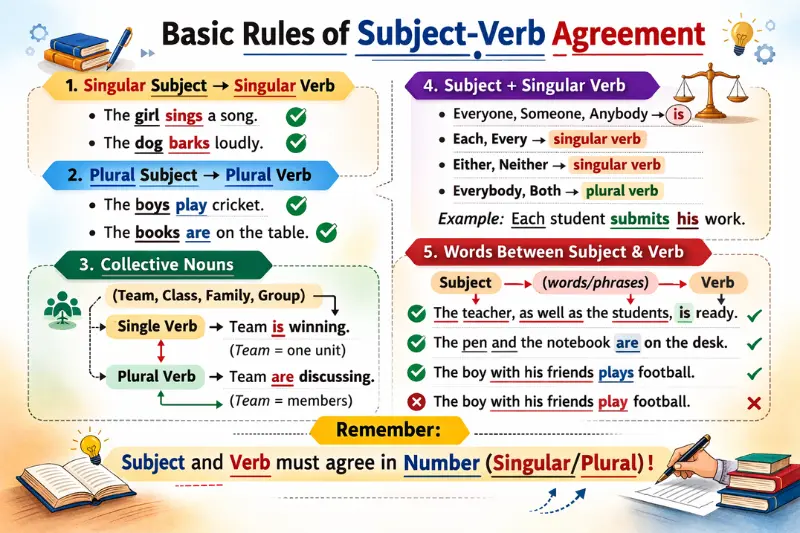
Here are the most important rules to follow:
1. Singular and Plural Subjects
- Singular subject → Singular verb
- Plural subject → Plural verb
Examples:
- She writes daily.
- They write daily.
2. Verb “Be” Conjugation
The verb be changes according to person and number:
| Person | Singular | Plural |
|---|---|---|
| First | I am | We are |
| Second | You are | You are |
| Third | He/She/It is | They are |
Examples:
- I am happy.
- She is a doctor.
- They are friends.
3. Compound Subjects
Subjects joined by “and” → plural verb
- Tom and Jerry are playing.
Subjects joined by “or” / “nor” → verb agrees with nearest subject
- Either the teacher or the students have the answer.
- Neither the students nor the teacher is present.
4. Indefinite Pronouns
Some pronouns are always singular: anyone, everyone, someone, nobody, each
- Example: Everyone is welcome.
Some pronouns are always plural: both, few, several
- Example: Both of the cats are sleeping.
5. Collective Nouns
A collective noun can be singular or plural depending on context:
- Singular (acting as a unit): The team is winning.
- Plural (individual members acting separately): The team are arguing among themselves.
6. Expressions of Time, Money, and Distance
Treated as singular when considered as a whole:
- Five dollars is enough.
- Ten years is a long time.
Plural if counted separately:
- Two hours have passed.
- Fifty dollars are in small bills.
7. Titles, Books, and Movies
Singular titles → singular verb
- The Lord of the Rings is amazing.
Plural titles → plural verb
- The Harry Potter movies are popular.
8. Sentences Beginning with Here / There
Verb agrees with the subject after the verb
- Here comes the bride.
- There are five books on the table.
9. Gerunds and Infinitives as Subjects
Gerunds (-ing verbs) → singular verb
- Swimming is fun.
Infinitives (to + verb) → singular verb
- To read is important.
10. Negative Sentences and Questions
Use do/does correctly:
- She does not like chocolate.
- Do you know the answer?
Advanced Subject-Verb Agreement Tips
If a prepositional phrase comes between subject and verb, ignore it:
- The box of chocolates is on the table.
Titles or nouns ending in -s but singular:
- Mathematics is difficult.
Words like each, every, either, neither are always singular:
- Each student has a book.
Expressions with fractions: verb agrees with the noun after “of”:
- One-half of the cake is gone.
- Two-thirds of the students are present.
Common Mistakes to Avoid
Using plural verb with singular indefinite pronoun:
- Wrong: Everyone are happy.
- Correct: Everyone is happy.
Confusing collective nouns:
- Wrong: The team are playing well. Only correct if members act separately.
Ignoring “here/there” rule:
- Wrong: Here are the bride.
- Correct: Here comes the bride.
Quick Exercise
Check the correct verb form:
Either John or Mary ___ coming to the party.
The news ___ shocking today.
Everyone ___ excited for the trip.
Five dollars ___ enough for lunch.
The team ___ practicing for the final match.
Conclusion
Mastering subject verb agreement rules in English grammar makes your writing clear, professional, and error-free. By following these 35+ rules, tips, and examples, you can confidently write correct sentences every time. Remember: always check the subject first, then choose the correct verb.