
Grammar rules are the foundation of effective communication. They help us organize words, express ideas clearly, and avoid confusion. Whether you are a student, blogger, or professional, understanding grammar rules can greatly improve your writing and speaking skills.
Good grammar is not about memorizing complicated rules. It is about writing clearly, confidently, and correctly.
Whether you are a student, professional, job seeker, or English learner, understanding grammar rules helps you:
- Communicate clearly
- Avoid embarrassing mistakes
- Improve academic writing
- Write better emails
- Score higher in exams
- Sound more professional
This guide explains grammar rules in simple language, provides real-life examples, highlights common mistakes, and includes a step-by-step improvement roadmap.
Let’s begin.
Table of Contents
What Are Grammar Rules?
Grammar rules are the structure of the English language. They explain:
- How words are formed
- How sentences are constructed
- How ideas are connected
- How punctuation is used
Without grammar rules, communication becomes confusing.
Example:
❌She go to school yesterday.
✅She went to school yesterday.
Small changes make a big difference.
The 15 Essential Grammar Rules Everyone Must Know
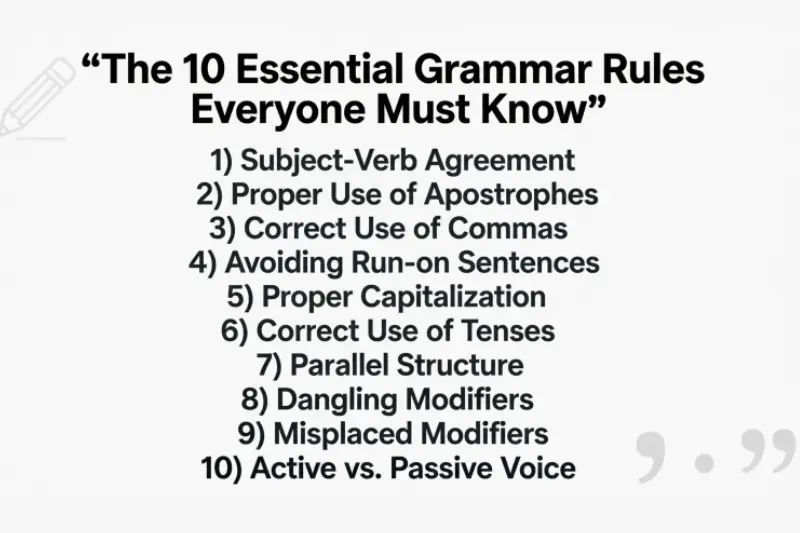
Below are the most important English grammar rules explained clearly.
May be you like it:
Words That Rhyme With Confusing: Complete Guide
Words Often Confused Worksheet: Learn, Practice, and Master English
Writing Tips First Person POV Using “I” a Lot – Complete Guide
1. Subject-Verb Agreement
The subject and verb must match in number.
- Singular subject → singular verb
- Plural subject → plural verb
Examples:
- She runs.
- They run.
Common mistake:
❌ Everyone are happy.
✅ Everyone is happy.
2. Proper Use of Articles (A, An, The)
- Use “a” before consonant sounds → a book
- Use “an” before vowel sounds → an apple
- Use “the” for specific things
Example:
- I saw a dog.
- The dog was barking loudly.
3. Correct Verb Tenses
Tense shows time (past, present, future).
Examples:
- I work. (Present)
- I worked. (Past)
- I will work. (Future)
Do not mix tenses in the same sentence.
❌ She went to the store and buys milk.
✅ She went to the store and bought milk.
4. Sentence Structure (Complete Sentences)
A complete sentence needs:
- A subject
- A verb
- A complete thought
Fragment:
❌ Because I was tired.
Complete sentence:
✅ I went to bed because I was tired.
5. Avoid Run-On Sentences
Do not join two independent clauses without punctuation.
❌ I love writing it helps me relax.
Correct versions:
✅ I love writing. It helps me relax.
✅ I love writing because it helps me relax.
6. Active Voice vs. Passive Voice
Active voice is clearer and stronger.
Active:
- The teacher explained the lesson.
Passive:
- The lesson was explained by the teacher.
Use active voice in most writing.
7. Proper Pronoun Usage
Pronouns must agree in number and clarity.
Confusing:
❌ When John met Mark, he was angry.
Clear:
✅ John was angry when he met Mark.
8.Correct Use of Prepositions
Prepositions show time, place, or direction.
Examples:
- At 5 PM
- On Monday
- In the room
Common mistake:
❌ She is married with him.
✅ She is married to him.
9. Parallel Structure
Keep items in a list in the same grammatical form.
Incorrect:
❌ She likes reading, to swim, and biking.
Correct:
✅ She likes reading, swimming, and biking.
10. Avoid Double Negatives
Use only one negative word.
❌ I don’t need no help.
✅ I don’t need any help.
11. Capitalization Rules
Capitalize:
- The first word in a sentence
- Proper nouns
- Days and months
Example:
- I visited London in July.
12. Correct Use of Commas
Use commas:
- In lists
- After introductory phrases
- Before coordinating conjunctions
Example:
- After dinner, we watched a movie.
13. Who vs. Whom
Use:
- Who → subject
- Whom → object
Example:
- Who called you?
- Whom did you invite?
14. Fewer vs. Less
- Fewer → countable nouns
- Less → uncountable nouns
Example:
- Fewer mistakes
- Less water
15. Conditionals (If Sentences)
Zero Conditional: General truths
- If you heat water, it boils.
First Conditional: Real future
- If it rains, we will stay home.
Second Conditional: Unreal present
- If I had money, I would travel.
Third Conditional: Unreal past
- If I had studied, I would have passed.
Common Grammar Mistakes and Quick Fixes
| Mistake | Correct Version |
|---|---|
| Your welcome | You’re welcome |
| Its raining | It’s raining |
| Their going | They’re going |
| Could of | Could have |
| More better | Better |
Grammar Rules for Professional Writing
Your competitors did not include this section.
When writing emails or business documents:
- Use active voice
- Avoid slang
- Keep sentences short
- Avoid filler words
- Use consistent tense
Example:
❌ Just wanted to quickly check if you maybe had time.
✅ Could you confirm your availability?
Grammar Rules for Exams (IELTS, TOEFL, Academic Writing)
Examiners check:
- Sentence variety
- Correct tense usage
- Complex sentences
- Subject-verb agreement
- Proper punctuation
Tip:
Use compound and complex sentences to improve your score.
Example:
- Although the results were unexpected, the team adapted quickly.
Grammar Learning Roadmap (Beginner to Advanced)
- Step 1: Learn parts of speech
- Step 2: Master sentence structure
- Step 3: Study verb tenses
- Step 4: Practice conditionals
- Step 5: Improve punctuation
- Step 6: Practice writing daily
Practice 15 minutes daily for real improvement.
Mini Practice Exercise
Correct the sentence:
- She don’t like coffee.
- I have less books than you.
- If I will see him, I tell him.
Answers:
- She doesn’t like coffee.
- I have fewer books than you.
- If I see him, I will tell him.
How to Improve Your Grammar Fast
- Read daily
- Write regularly
- Review your mistakes
- Use grammar checking tools wisely
- Study one rule at a time
- Practice speaking clearly
Consistency beats memorization.
Frequently Asked Questions
What are the most important grammar rules?
Subject-verb agreement, correct tense usage, sentence structure, punctuation, and active voice are the most important rules.
How can I improve grammar quickly?
Practice daily, focus on common mistakes, and read quality English writing.
Why are grammar rules important?
Grammar ensures clarity, professionalism, and effective communication.
Conclusion
Grammar rules are not barriers to creativity-they are the foundation of clear and confident communication. When you understand how sentences work, how verbs match subjects, and how punctuation shapes meaning, your writing becomes stronger, sharper, and more professional.
You do not need to master everything at once. Focus on one grammar rule at a time. Practice regularly. Review your mistakes. Apply what you learn in real writing situations-emails, essays, reports, or everyday messages.
Strong grammar skills will help you:
- Express ideas clearly
- Avoid common writing mistakes
- Improve academic and exam performance
- Build credibility in professional settings
- Communicate with confidence
Consistency matters more than perfection. With steady practice and awareness, your grammar will improve naturally over time.
Start today, stay consistent, and let clear grammar support your success.
May be you like it:
SEO Agency in Australia UploadArticle: The Complete Guide to Choosing the Right Partner in 2026
The Ultimate Guide to UploadArticle: Boost Your SEO & Reach More Readers
UploadArticle Relationship: The Complete Strategy to Get Published, Approved & Ranked