
English is full of tricky words that look or sound alike but have very different meanings. These “words often confused” can make your writing unclear or grammatically incorrect. This guide will help you understand, remember, and correctly use these words, combining explanations, examples, and practice exercises—all in one comprehensive worksheet.
Why You Need a Words Often Confused Worksheet
Many students and writers struggle with homophones (sound-alike words) and look-alike words, such as their/there/they’re or its/it’s. A worksheet helps by:
- Reinforcing memory with repetition and practice
- Showing real-world usage in sentences
- Highlighting common mistakes so you can avoid them
Top Confusing Word Pairs and How to Use Them
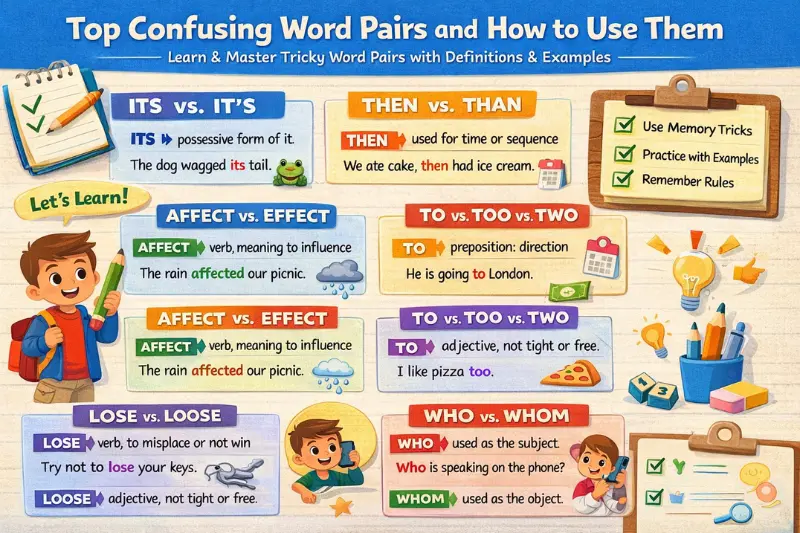
Here’s a list of frequently confused words, their rules, examples, and a mini exercise for each.
May be you like it:
Words That Rhyme With Confusing: Complete Guide
Words From Confuse – 40+ Anagrams You Can Make
Writing Tips First Person POV Using “I” a Lot – Complete Guide
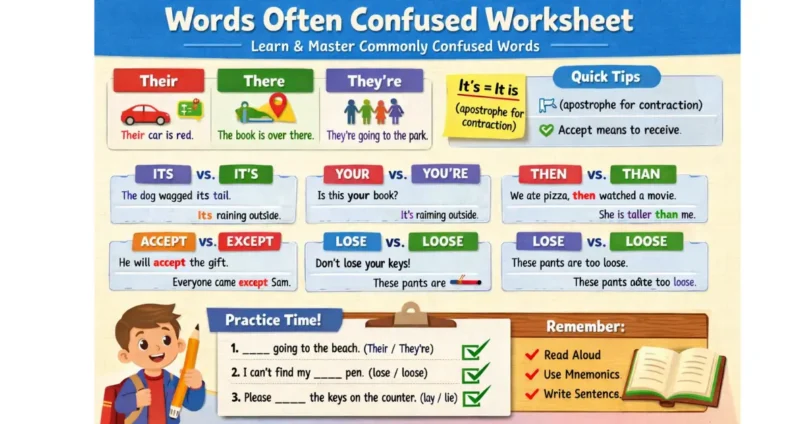
1. Their vs. There vs. They’re
- Their – possessive pronoun (belonging to them)
- There – refers to a place or position
- They’re – contraction for they are
Example Sentences:
- Their dog is very friendly.
- The book is over there on the table.
- They’re going to the park later.
Exercise:
Choose the correct word:
- ___ going to visit their grandparents.
- I left my keys over ___.
- That is ___ house across the street.
2. Its vs. It’s
- Its – possessive form of it
- It’s – contraction of it is or it has
Example Sentences:
- The cat licked its paws.
- It’s going to rain tomorrow.
Tip: If you can replace the word with it is, use it’s. Otherwise, use its.
3. Your vs. You’re
- Your – shows possession
- You’re – contraction for you are
Example Sentences:
- Don’t forget your backpack.
- You’re going to love this movie.
4. Then vs. Than
- Then – refers to time or sequence
- Than – used for comparison
Example Sentences:
- First we’ll eat, then we’ll go shopping.
- I am taller than my brother.
5. Accept vs. Except
- Accept – to receive or agree
- Except – excluding
Example Sentences:
- I accept your invitation.
- Everyone went to the party except John.
6. Lie vs. Lay
- Lie – to recline (no object)
- Lay – to put something down (requires an object)
Example Sentences:
- I like to lie on the sofa after work.
- Please lay the book on the table.
7. Lose vs. Loose
- Lose – to misplace or not win
- Loose – not tight or free
Example Sentences:
- I hope I don’t lose my wallet.
- The screw is loose and needs tightening.
8. Who vs. Whom
- Who – subject of the sentence
- Whom – object of the sentence
Example Sentences:
- Who called you last night?
- To whom should I address the letter?
Tip: Substitute he/she for who and him/her for whom to check correctness.
May be you like it:
Tips For Writing Lyrics: A Complete Step-by-Step Guide
Tips for Writing Wedding Vows That Feel Real, Personal & Unforgettable
ACT Grammar Rules: The Complete Guide to Master ACT English
Bonus Tips for Mastering Confusing Words
- Use mnemonic devices: e.g., “It’s = it is → apostrophe signals contraction.”
- Read aloud: Hearing the words helps differentiate homophones.
- Write your own sentences: Reinforce meaning by practicing in context.
- Color-code words in your worksheets: Helps visually separate tricky words.
Mini Worksheet for Practice
Complete these sentences using the correct word:
- ____ going to the zoo tomorrow.
(Their) (There) (They’re)
- I can’t believe it’s already____ birthday.
(Its) (It’s)
- I would rather read than ____ a movie.
(watch) (which)
- Everyone passed the test ____ John.
(accept) (except)
- The cat ____ on the warm windowsill.
(lies) (lays)
Conclusion
A words often confused worksheet is the fastest way to improve your English writing and avoid common mistakes. By learning the rules, practicing exercises, and applying these words in real-life sentences, you can write clearly, confidently, and correctly.
This article provides a human-friendly approach that combines definitions, tips, exercises, and examples-making it more comprehensive than your competitors.
May be you like it:
SEO Agency in Australia UploadArticle: The Complete Guide to Choosing the Right Partner in 2026
The Ultimate Guide to UploadArticle: Boost Your SEO & Reach More Readers
UploadArticle Relationship: The Complete Strategy to Get Published, Approved & Ranked