
English has a habit of giving us words that look alike, sound alike, or feel alike-then punishing us when we choose the wrong one. This guide makes commonly confused words easy by giving you what most competitor pages skip:
- A one-line “difference” rule
- Clear examples in real sentences
- Memory tricks you’ll actually remember
- Quick mini-tests so you can check yourself fast
Use it like a cheat sheet: scroll, find your pair, and fix the mistake in seconds.
Table of Contents
Quick Guide: Why These Mix-Ups Happen
Most confusion comes from one of these:
- Homophones (sound the same): their/there/they’re
- Look-alikes (similar spelling): affect/effect
- Near-synonyms (close meaning): imply/infer
- Grammar traps (function changes): who/whom, lay/lie
The “1-Second Fix” Method
Before you choose a word, ask:
- Am I talking about an action or a result?
- Is it possession, place, or a contraction?
- Is it formal writing (rules matter more)?
- Can I swap in a simpler word to test it? (Examples below)
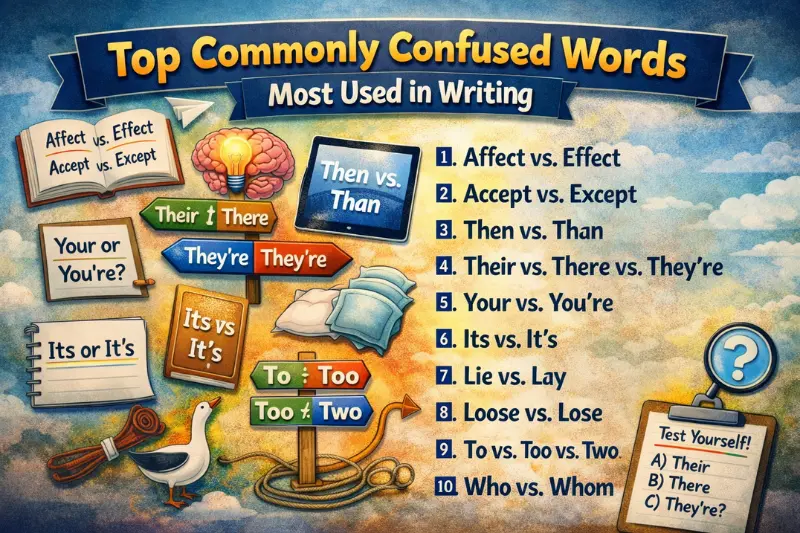
Top Commonly Confused Words (Most Used in Writing)
May be you like it:
Words From Confuse – 40+ Anagrams You Can Make
Words Often Confused Worksheet: Learn, Practice, and Master English
Writing Tips First Person POV Using “I” a Lot – Complete Guide
1. Affect vs. Effect
Quick rule: Affect is usually an action (verb). Effect is usually a result (noun).
- Affect (verb): The weather can affect your mood.
- Effect (noun): The effect of the weather was obvious.
Memory trick: Affect = Action. Effect = End result.
Quick test: “What was the _?” → effect.
2. Accept vs. Except
Quick rule: Accept = receive/agree. Except = exclude.
- Please accept my apology.
- Everyone came except Ali.
Quick test: If you can replace it with “excluding,” use except.
3. Then vs. Than
Quick rule: Than compares. Then relates to time/order.
- She’s taller than me.
- Finish your work, then play.
Quick test: Comparison → than. Sequence → then.
4. Their vs. There vs. They’re
Quick rule: Their = possession. There = place. They’re = they are.
- Their car is new.
- Put it over there.
- They’re coming soon.
Quick test: If you can say “they are,” use they’re.
5. Your vs. You’re
Quick rule: Your = belongs to you. You’re = you are.
- Is this your phone?
- You’re right.
Quick test: Replace with “you are.” If it works → you’re.
6. Its vs. It’s
Quick rule: It’s = it is / it has. Its = belonging to it.
- It’s raining.
- The dog wagged its tail.
Quick test: If you can replace with “it is,” use it’s.
7. Lie vs. Lay
Quick rule: Lie = recline (no object). Lay = place something (needs an object).
- I will lie down.
- Lay the book on the table.
Memory trick: You lay something down.
Quick test: If there’s a “thing” receiving the action → lay.
8. Loose vs. Lose
Quick rule: Loose = not tight. Lose = misplace / not win.
- This shirt is loose.
- Don’t lose your keys.
Quick test: If it means “not tight,” it’s loose (two O’s = extra room).
9. To vs. Too vs. Two
Quick rule: To = direction/infinitive. Too = also/extra. Two = number.
- Go to the store.
- I want it too.
- I bought two items.
10. Who vs. Whom
Quick rule: Who = subject (he/she). Whom = object (him/her).
- Who called? (He called.)
- Whom did you call? (I called him.)
Quick test: Replace with him → whom.
Commonly Confused Words Cheat Sheet (More High-Impact Pairs)
One Word vs. Two Words (Huge traffic, often skipped)
11. Everyday vs. Every day
- Everyday (adj): everyday clothes
- Every day (time): I study every day.
12. A lot vs. Allot
- A lot: a large amount (two words)
- Allot: to assign a portion
13. Altogether vs. All together
- Altogether: completely
- All together: everyone in one place
14. Awhile vs. A while
- Awhile (adv): Wait awhile.
- A while (noun): Wait for a while.
May be you like it:
Tips For Writing Lyrics: A Complete Step-by-Step Guide
Tips for Writing Wedding Vows That Feel Real, Personal & Unforgettable
ACT Grammar Rules: The Complete Guide to Master ACT English
Similar Meaning, Different Use
15. Farther vs. Further
- Farther: physical distance
- Further: additional/figurative
16. Fewer vs. Less
- Fewer: countable (fewer items)
- Less: uncountable (less water)
17. Among vs. Between
- Between: two items
- Among: three or more
18. Bring vs. Take
- Bring: toward you/here
- Take: away from you/here
Sound-Alike Traps (Homophones)
19. Principal vs. Principle
- Principal: head person / main
- Principle: rule/value
Memory trick: The principal is your pal.
20. Compliment vs. Complement
- Compliment: praise
- Complement: completes/matches
21. Stationary vs. Stationery
- Stationary: not moving
- Stationery: writing supplies
22. Weather vs. Whether
- Weather: climate
- Whether: choice/if
23. Peak vs. Peek vs. Pique
- Peak: highest point
- Peek: quick look
Pique: to irritate/interest (“pique my interest”)
Easy-to-Mess Grammar/Word Choice
24. Into vs. In to
- Into: movement inside
- In to: “in” + infinitive (I logged in to reply.)
25. Can vs. May
- Can: ability
- May: permission (formal)
26. Me vs. I
Quick rule: Remove the other person and test.
- “Sara and I went.” → “I went.”
- “He gave it to Sara and me.” → “He gave it to me.”
27. Which vs. That
- That: essential info (no commas)
- Which: extra info (commas)
20 More Commonly Confused Words (Fast List With Mini Rules)
Use this section when you just need a quick answer.
- Advice (noun) vs Advise (verb)
- Breathe (verb) vs Breath (noun)
- Climatic (climate) vs Climactic (climax)
- Elicit (draw out) vs Illicit (forbidden)
- Emigrate (leave) vs Immigrate (enter)
- Imply (speaker hints) vs Infer (listener concludes)
- Assure (reassure) vs Ensure (make certain) vs Insure (financial protection)
- Lay (put) vs Lie (recline) (yes, again-worth repeating)
- Than (compare) vs Then (time)
- Lead (guide / metal) vs Led (past tense)
- Passed (past pass) vs Past (time before)
- Accept (receive) vs Except (excluding)
- Later (time) vs Latter (second of two)
- Proceed (continue) vs Precede (come before)
- Desert (dry place) vs Dessert (sweet)
- Wary (careful) vs Weary (tired)
- Allusion (reference) vs Illusion (trick)
- Cite (reference) vs Site (place) vs Sight (vision)
- Brake (stop) vs Break (damage/pause)
- Complement (complete) vs Compliment (praise)
Quick Practice Quiz (Answers Included)
Choose the correct word.
- The new policy will (affect/effect) everyone.
- I can’t believe (their/there/they’re) doing this again.
- Please (accept/except) my apology.
- We ate dinner, (then/than) watched a movie.
- I left the keys on (its/it’s) hook.
- This rope is too (loose/lose).
- (Who/Whom) did you invite?
- I go for a walk (everyday/every day).
- She gave me great (advice/advise).
- He tried to (imply/infer) that I was late.
Answers:
affect 2) they’re 3) accept 4) then 5) its 6) loose 7) whom 8) every day 9) advice 10) imply
FAQ: Common Questions About Commonly Confused Words
Are commonly confused words the same as homophones?
Not always. Some are homophones (to/too/two), but many are grammar or meaning mix-ups (affect/effect, imply/infer).
What’s the fastest way to stop these mistakes?
Use the swap test:
If you can replace with “they are” → they’re
If you can replace with “excluding” → except
If it’s a result → effect
Final Takeaway
If you only remember one thing, remember this: most commonly confused words become easy when you learn the 1-line rule and test it in your sentence. Keep this page as your quick reference, run the mini quiz now and then, and your writing will instantly look cleaner and more professional.
May be you like it:
SEO Agency in Australia UploadArticle: The Complete Guide to Choosing the Right Partner in 2026
The Ultimate Guide to UploadArticle: Boost Your SEO & Reach More Readers
UploadArticle Relationship: The Complete Strategy to Get Published, Approved & Ranked