
Writing lyrics is not about waiting for inspiration. It is about using structure, emotion, rhythm, and storytelling to create something people feel and remember.
Whether you’re a beginner songwriter or improving your craft, these practical tips for writing lyrics will help you write stronger verses, unforgettable hooks, and emotionally powerful songs.
Let’s break it down step by step.
Table of Contents
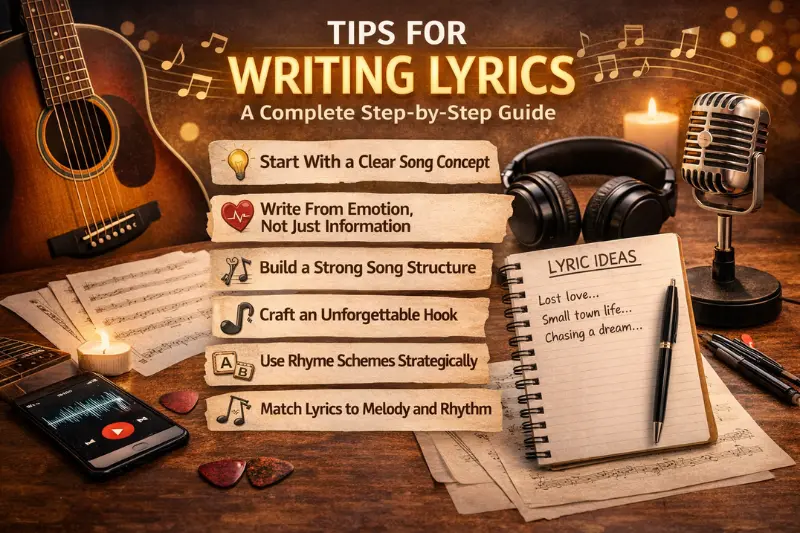
1. Start With a Clear Song Concept
Every strong lyric begins with a clear idea.
Before you write, ask:
- What is this song about?
- What emotion drives it?
- What is the main message?
A weak concept leads to a confusing lyric. A focused concept creates direction.
Pro Tip: Use the “One Sentence Rule”
Summarize your song in one sentence.
Example:
“This is a song about finally letting go of someone who never chose me.”
If you cannot explain it clearly, your listener will not understand it either.
2. Write From Emotion, Not Just Information
People connect to feelings, not explanations.
Instead of telling the listener how you feel, show them.
Weak:
I feel lonely without you.
Stronger:
Your side of the bed stays cold at night.
Use:
- Sensory details
- Specific images
- Emotional contrast
- Real-life moments
This makes your lyrics relatable and vivid.
May be you like it:
Words That Rhyme With Confusing: Complete Guide
Words Often Confused Worksheet: Learn, Practice, and Master English
Writing Tips First Person POV Using “I” a Lot – Complete Guide
3. Build a Strong Song Structure
Many beginner lyricists struggle because they do not understand structure.
Here is a simple songwriting structure:
- Verse 1 – Set the scene
- Verse 2 – Add detail or conflict
- Chorus – Deliver the main message (the hook)
- Bridge – Offer a new perspective or twist
Why Structure Matters
Structure controls emotional build. It keeps your lyric focused and prevents rambling.
4. Craft an Unforgettable Hook
The hook is the most important part of your song.
It should:
- Be easy to remember
- Be emotionally powerful
- Contain the main idea
- Sound good when sung
Hook Formula
Hook = Core Emotion + Clear Message + Rhythm
Example:
“I won’t wait another day.”
Keep it short. Keep it strong.
Place it:
- At the end of the chorus
- Possibly at the beginning too
Repetition makes it memorable.
5. Use Rhyme Schemes Strategically
Rhyme improves flow and memorability.
Common rhyme schemes:
- AABB
- ABAB
- AAAA
Example (AABB):
I drive past your street at night
The porch light still shining bright
I tell myself I’m doing fine
But you still cross my mind
Advanced Tip
Use:
- Internal rhyme (rhymes inside lines)
- Multisyllabic rhyme
- Slant rhyme (near rhyme)
These techniques make lyrics sound modern and professional.
6. Match Lyrics to Melody and Rhythm
Many articles ignore this – but it is crucial.
Lyrics are meant to be sung, not just read.
Check:
- Syllable count
- Stress pattern
- Natural word emphasis
If the melody stresses the wrong syllable, the line feels awkward.
Example:
Wrong stress:
I re-MEM-ber you
Better:
I REM-em-ber you
Sing your lyrics out loud while writing.
If it feels unnatural, adjust.
7. Make Every Line Move the Story Forward
A common mistake is repeating the same idea in different words.
Ask yourself:
- Does this line add new information?
- Does it deepen emotion?
- Does it build tension?
If not, cut it.
Strong lyrics are tight and purposeful.
8. Use Metaphors Carefully (And Stay Consistent)
Metaphors add depth.
Example:
Love as a storm.
Heartbreak as a burning house.
But once you choose a metaphor, stay consistent.
If your song compares love to the ocean, avoid suddenly mentioning fire unless it makes sense.
Consistency keeps your lyric focused.
9. Use the “Less Is More” Editing Rule
Great songs are rewritten, not just written.
After drafting:
- Remove unnecessary words
- Replace weak verbs
- Shorten long lines
- Strengthen imagery
Weak:
I was really feeling very sad that night
Stronger:
That night hit hard.
Shorter. Stronger. More emotional.
May be you like it:
Words From Confuse – 40+ Anagrams You Can Make
Tips for Writing Wedding Vows That Feel Real, Personal & Unforgettable
ACT Grammar Rules: The Complete Guide to Master ACT English
10. Write With Today’s Listener in Mind
Modern listeners have short attention spans.
Streaming platforms reward:
- Strong first 15 seconds
- Early hook entry
- Memorable punchlines
- Loop-friendly choruses
Do not wait too long to deliver impact.
Grab attention early.
11. Try These Lyric Writing Exercises
Here are exercises competitors rarely include:
5-Minute Object Writing
Pick an object.
Describe it using all five senses.
Do not judge. Just write.
Title Brainstorm
Write 20 possible song titles.
Pick the most emotionally powerful one.
Emotion Scaling
Write a verse at emotional level 4.
Write the chorus at emotional level 9.
This builds dynamic contrast.
12. Avoid These Common Lyric Writing Mistakes
- Writing clichés
- Overexplaining feelings
- Ignoring rhythm
- Using filler words
- Forgetting the hook
- Inconsistent metaphor
- Too many ideas in one song
Simplicity wins.
Final Lyric Writing Checklist
Before finishing your song, ask:
- Is the concept clear?
- Is the hook unforgettable?
- Does every line move the story forward?
- Are the images vivid?
- Does it sing naturally?
- Is the chorus emotionally powerful?
- Did I edit unnecessary words?
If yes – you have a strong lyric.
Conclusion
Writing great lyrics is a balance between emotion and technique. Inspiration may spark the idea, but structure, clarity, rhythm, and thoughtful editing turn that idea into a powerful song.
When you focus on a strong concept, build a memorable hook, use vivid imagery, maintain consistent rhyme schemes, and make every line serve the story, your lyrics become more than words – they become experiences listeners can feel.
Remember:
- Keep your message clear.
- Show emotion through detail.
- Make your chorus unforgettable.
- Edit without mercy.
The more consistently you practice these tips for writing lyrics, the more naturally strong songwriting will come to you. Every song you write improves your craft.
Start small. Stay consistent. Keep refining.
May be you like it:
SEO Agency in Australia UploadArticle: The Complete Guide to Choosing the Right Partner in 2026
The Ultimate Guide to UploadArticle: Boost Your SEO & Reach More Readers
UploadArticle Relationship: The Complete Strategy to Get Published, Approved & Ranked