
Learning Arabic often feels intimidating at first. Many beginners assume it’s one of the hardest languages in the world because of its script, pronunciation, and unfamiliar structure. But the truth is, once you understand the arabic language grammar rules, everything starts to fall into place in a logical and predictable way.
Arabic isn’t as confusing as it seems-it simply works differently from English. Instead of memorizing random rules, you learn patterns that repeat across the language. This is what makes arabic grammar powerful and, over time, much easier to manage.
If you’re just starting out, don’t worry. You don’t need to master everything at once. By focusing on the basics and building step by step, you’ll quickly gain confidence and begin forming sentences naturally.
What Are Arabic Language Grammar Rules?
Arabic language grammar rules are the guidelines that explain how words are formed and how sentences are structured in the language. In simple terms, grammar in Arabic helps you understand how to combine nouns, verbs, and particles correctly so your sentences make sense.
These rules are important because they allow you to communicate clearly and accurately. Without proper grammar Arabic, even simple sentences can become confusing or misleading. When you understand how grammar works, you can read, write, and speak with confidence.
What makes Arabic different from English is how the language is built. Arabic relies heavily on patterns and word roots rather than fixed word order. While English depends on sentence position (Subject + Verb + Object), Arabic can be more flexible because meaning often comes from word forms and endings. This system may feel unfamiliar at first, but once you understand it, it actually becomes easier to recognize patterns and build sentences correctly.
May be you like it:
Words From Confuse – 40+ Anagrams You Can Make
Words Often Confused Worksheet: Learn, Practice, and Master English
Writing Tips First Person POV Using “I” a Lot – Complete Guide
Arabic Language Basics Every Beginner Should Know
Understanding the arab language basics is the first step toward mastering Arabic. While it may seem complex at first glance, knowing these foundational elements will make learning arabic grammar much easier.
Arabic Alphabet Overview
Arabic has 28 letters, each with up to four different forms depending on its position in a word: initial, medial, final, or isolated. Unlike English, Arabic letters are connected in cursive style, which makes reading flow smoothly once you become familiar with the shapes.
Right-to-Left Writing
Arabic is written from right to left. This direction affects not only reading but also writing numbers, punctuation, and even sentence flow. Beginners often need practice to adjust, but once you’re used to it, reading Arabic feels natural.
Root System
One of the most important arab language basics is the root system. Most Arabic words are built from a three- or four-letter root, which carries the core meaning. By adding vowels and prefixes or suffixes, you can create nouns, verbs, adjectives, and more from a single root.
For example:
- Root: ك-ت-ب (k-t-b) – related to writing
- كتب (kataba) – he wrote
- كتاب (kitab) – book
- مكتبة (maktaba) – library
This system makes learning vocabulary and grammar much more systematic than memorizing isolated words. Once you understand roots, you’ll start noticing patterns across the language, which helps with both comprehension and sentence formation.
The 3 Core Parts of Arabic Grammar
To understand grammar in Arabic, it’s essential to know its three core components: nouns, verbs, and particles. These form the building blocks of every sentence.
Nouns (Ism)
Nouns in Arabic are called Ism. They refer to people, places, things, or ideas. Nouns can be masculine or feminine, singular, dual, or plural, and they follow specific patterns for case endings (nominative, accusative, genitive).
Examples:
- رَجُل (rajul) – man
- مَرْأَة (mar’ah) – woman
- كِتَاب (kitab) – book
- مَدْرَسَة (madrasa) – school
- Verbs (Fi’l)
Verbs, called Fi’l, describe actions and are conjugated based on tense (past, present, future), person (I, you, he, she, etc.), and number (singular, dual, plural). Arabic verbs also follow root patterns, making them predictable once you learn the system.
Examples:
- كَتَبَ (kataba) – he wrote
- يَكْتُبُ (yaktubu) – he writes
- سَيَكْتُبُ (sayaktubu) – he will write
- Particles (Harf)
Particles, known as Harf, are words that connect or modify sentences. They don’t have a fixed meaning on their own but are essential in forming correct sentence structures.
Examples:
- وَ (wa) – and
- فِي (fi) – in
- مِن (min) – from
- لِـ (li) – for/to
By mastering these three elements – nouns, verbs, and particles – beginners can start building simple and accurate Arabic sentences.
Arabic Sentence Structure Explained
Understanding Arabic sentence structure is crucial for forming grammatically correct sentences. Unlike English, Arabic often follows patterns that depend on whether the sentence is verbal or nominal.
Verbal Sentences (Verb First)
In verbal sentences, the verb comes first, followed by the subject and then the object. This is common when describing actions.
Example:
كَتَبَ الطَّالِبُ الدَّرْسَ (Kataba al-talibu al-darsa) – The student wrote the lesson.
Nominal Sentences (Noun First)
In nominal sentences, the sentence begins with a noun (subject), followed by the predicate. These sentences often describe states, qualities, or identity rather than actions.
Example:
- الجوُّ جَمِيلٌ (Al-jawwu jameelun) – The weather is beautiful.
Table: Arabic Sentence Structure Examples
| Type | Structure | Example | Meaning |
|---|---|---|---|
| Verbal Sentence | Verb + Subject + Object | كَتَبَ الطَّالِبُ الدَّرْسَ | The student wrote the lesson |
| Nominal Sentence | Subject + Predicate | الجوُّ جَمِيلٌ | The weather is beautiful |
This table helps beginners quickly visualize how Arabic sentence structure differs from English and makes it easier to practice forming sentences correctly.
Gender Rules in Arabic Grammar
In Arabic, every noun has a gender: either masculine or feminine. Understanding gender is essential because it affects adjectives, verbs, and pronouns that agree with the noun.
Masculine vs Feminine
Masculine nouns typically have no special ending.
Feminine nouns often end with -ة (taa marbuta).
Examples:
- Masculine: رَجُل (rajul) – man
- Feminine: مَرْأَة (mar’a) – woman
How to Identify Gender
- Look at the noun ending: words ending in -ة are usually feminine.
- Some nouns have natural gender (like professions or animals).
- Context and common usage also help.
Adjective Agreement
Adjectives must match the noun in gender and number.
Examples:
- Masculine: رَجُل طَوِيل (rajul taweel) – tall man
- Feminine: مَرْأَة طَوِيلَة (mar’a taweela) – tall woman
Table: Gender Rules in Arabic Grammar
| Gender | Noun Example | Adjective Example | Meaning |
|---|---|---|---|
| Masculine | رَجُل | طَوِيل | Tall man |
| Feminine | مَرْأَة | طَوِيلَة | Tall woman |
This table helps beginners see how grammar in Arabic is closely tied to gender rules, making sentence construction easier and more accurate.
Singular, Dual, and Plural Forms
Arabic nouns and verbs have a three-number system: singular, dual, and plural. Understanding this system is key to forming correct sentences and using grammar in Arabic effectively.
Singular (Mufrad)
The singular form refers to one item or person. It is the base form of the noun or verb.
Example:
- كِتاب (kitaab) – book
- طَالِب (taalib) – student
Dual (Muthanna)
The dual form is used to refer to two items or people. It is formed by adding -انِ (-aani) in the nominative case and -يْنِ (-ayni) in the accusative and genitive cases.
Example:
- كِتابانِ (kitaabaani) – two books
- طَالِبَانِ (taalibaani) – two students
Plural (Jama’)
The plural form refers to three or more items or people. Arabic has two types of plurals:
- Sound plural (regular) – masculine adds -ونَ (-oon), feminine adds -ات (-aat)
- Broken plural (irregular) – internal changes in the word structure
Examples:
- Sound plural masculine: مُعَلِّمُونَ (mu’allimoon) – teachers
- Sound plural feminine: مُعَلِّمَات (mu’allimaat) – female teachers
- Broken plural: كُتُب (kutub) – books
Table: Singular, Dual, and Plural Forms
| Number | Noun Example | Meaning | Notes |
|---|---|---|---|
| Singular | كِتاب | Book | Base form |
| Dual | كِتابانِ | Two books | Add -انِ for nominative |
| Plural | كُتُب | Books | Broken plural (irregular) |
| Plural | مُعَلِّمُونَ | Teachers | Sound plural masculine |
| Plural | مُعَلِّمَات | Female teachers | Sound plural feminine |
This system is foundational for mastering Arabic grammar rules, especially when constructing Arabic sentence structures that require correct number agreement.
May be you like it:
Tips For Writing Lyrics: A Complete Step-by-Step Guide
Tips for Writing Wedding Vows That Feel Real, Personal & Unforgettable
ACT Grammar Rules: The Complete Guide to Master ACT English
Arabic Verb Tenses Made Easy

Verbs are a core part of grammar in Arabic, and mastering the tenses helps you form clear and accurate sentences. Arabic verbs primarily appear in three tenses: past, present, and future.
Past Tense (الماضي – Al-Maadi)
The past tense is used to describe completed actions. In Arabic, verbs are conjugated according to the subject.
Examples:
- كَتَبَ (kataba) – He wrote
- كَتَبَتْ (katabat) – She wrote
- كَتَبْنَا (katabna) – We wrote
Present Tense (المضارع – Al-Mudari’)
The present tense describes ongoing or habitual actions. It uses prefixes depending on the subject.
Examples:
- يَكْتُبُ (yaktubu) – He writes
- تَكْتُبُ (taktubu) – She writes
- نَكْتُبُ (naktubu) – We write
Future Tense (المستقبل – Al-Mustaqbal)
The future tense is formed by adding سـ (sa-) or سوف (sawfa) before the present tense verb.
Examples:
- سَيَكْتُبُ (sayaktubu) – He will write
- سَتَكْتُبُ (sataktubu) – She will write
- سَنَكْتُبُ (sanaktubu) – We will write
Table: Arabic Verb Tenses
| Tense | Arabic Example | Meaning | Notes |
|---|---|---|---|
| Past | كَتَبَ | He wrote | Action completed |
| Past | كَتَبَتْ | She wrote | Feminine singular |
| Present | يَكْتُبُ | He writes | Ongoing action |
| Present | تَكْتُبُ | She writes | Feminine singular |
| Future | سَيَكْتُبُ | He will write | Use prefix سـ (sa-) or سوف |
| Future | سَتَكْتُبُ | She will write | Feminine singular |
This section simplifies Arabic grammar rules for beginners and helps learners understand verb conjugation in different tenses.
Adjectives in Arabic Grammar: Agreement and Placement
Adjectives in Arabic grammar are slightly different from English because they must agree with the noun they describe in gender, number, and definiteness. Understanding this is key for forming correct sentences.
Gender Agreement
Adjectives change based on whether the noun is masculine or feminine.
Examples:
- Masculine: رَجُل طَويل (rajul tawil) – A tall man
- Feminine: امرأة طَويلة (imra’ah tawilah) – A tall woman
Notice the extra ـة (–ah) ending in feminine adjectives.
Number Agreement
Adjectives must match whether the noun is singular, dual, or plural.
Examples:
Singular: كتاب جديد (kitab jadid) – A new book
Dual: كتابان جديدان (kitaban jadidan) – Two new books
Plural: كتب جديدة (kutub jadidah) – New books
Definiteness Agreement
If the noun is definite (with ال – al-), the adjective also becomes definite.
Examples:
- Indefinite: رَجُل طَويل – A tall man
- Definite: الرَجُل الطَويل – The tall man
Table: Adjective Agreement in Arabic
| Noun Type | Example (Arabic) | Meaning | Notes |
|---|---|---|---|
| Masculine Singular | رَجُل طَويل | A tall man | Basic masculine form |
| Feminine Singular | امرأة طَويلة | A tall woman | Extra ـة ending for feminine |
| Dual Masculine | رجلان طَويلان | Two tall men | ـان ending for dual |
| Dual Feminine | امرأتان طويلتان | Two tall women | Dual feminine agreement |
| Plural Masculine | رجال طِوال | Tall men | Masculine plural |
| Plural Feminine | نساء طِويلات | Tall women | Feminine plural |
Key Takeaways
- Always match gender, number, and definiteness.
- Placement: Adjective usually follows the noun.
- Adjective endings are essential for correct meaning.
Common Mistakes in Arabic Grammar and How to Avoid Them
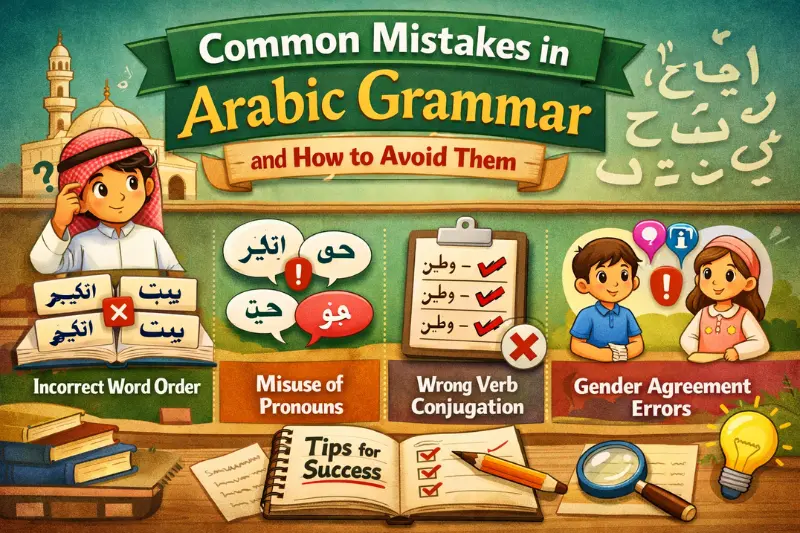
Even beginners following Arabic language grammar rules often make mistakes. Understanding these common pitfalls can help you avoid confusion and speak or write correctly.
Misplacing Adjectives
Mistake: Placing the adjective before the noun (like English) instead of after.
Correct: رَجُل طَويل – A tall man
Incorrect: طَويل رَجُل
In Arabic grammar, adjectives always follow the noun they describe.
Ignoring Gender and Number Agreement
Mistake: Using the wrong adjective ending.
Correct: امرأة طَويلة – A tall woman
Incorrect: امرأة طويل
Adjectives must match gender and number of the noun.
Forgetting Dual Forms
Mistake: Using singular or plural forms for dual nouns.
Correct: كتابان جديدان – Two new books
Incorrect: كتاب جديد or كتب جديدة
Dual forms have unique endings: -ان / -ين depending on case.
Misusing Verb Tenses
Mistake: Mixing past, present, and future forms incorrectly.
Correct Examples:
Past: كتبَ الطالبُ الدرسَ – The student wrote the lesson
Present: يكتبُ الطالبُ الدرسَ – The student writes the lesson
Future: سيكتبُ الطالبُ الدرسَ – The student will write the lesson
Always ensure the verb agrees with tense, subject, and number.
Confusing Verbal vs Nominal Sentences
Mistake: Using a verb-first structure where a noun-first sentence is needed.
Verbal sentence: ذهبَ الولدُ إلى المدرسة – The boy went to school
Nominal sentence: الولدُ مجتهدٌ – The boy is hardworking
Understanding Arabic sentence structure is key to clarity.
Overusing Direct English Translations
Mistake: Translating English phrases word-for-word into Arabic.
Correct: أحب القراءة – I love reading
Incorrect: أنا أحب to read
Arabic has its own grammar rules; direct translation often leads to errors.
Table: Common Arabic Grammar Mistakes
| Mistake Type | Example (Incorrect) | Correct Example | Tip for Beginners |
|---|---|---|---|
| Adjective placement | طويل رجل | رجل طويل | Adjective follows the noun |
| Gender/number mismatch | امرأة طويل | امرأة طويلة | Match adjective endings |
| Ignoring dual forms | كتاب جديد | كتابان جديدان | Learn dual endings -ان / -ين |
| Verb tense error | يكتب الطالب الدرسَ (past) | كتب الطالب الدرسَ | Match tense to action |
| Verbal vs nominal confusion | الولد مجتهد | الولد مجتهدٌ | Know sentence type |
| Direct translation from English | أنا أحب to read | أحب القراءة | Think in Arabic, not English |
Pro Tip for Beginners:
Practice small sentences daily. Correct mistakes early to build confidence and a strong foundation in Arabic grammar.
Arabic Language Grammar Rules Examples for Beginners
To truly master Arabic language grammar rules, beginners need practical examples. This section will give you simple, clear sentences showing how Arabic grammar works in real life.
Simple Noun and Adjective Agreement
| Arabic | Transliteration | English | Notes |
|---|---|---|---|
| ولد صغير | Walad sagheer | A small boy | Adjective follows noun; masculine singular |
| بنت جميلة | Bint jameela | A beautiful girl | Adjective matches feminine singular noun |
| كتابان مفيدان | Kitaban mufeedan | Two useful books | Dual noun form, adjective agrees |
| كتب مفيدة | Kutub mufeedah | Useful books | Plural noun, adjective agrees in feminine plural |
Tip: Always ensure adjectives match the gender and number of nouns.
Verb Usage Examples
| Arabic | Transliteration | English | Notes |
|---|---|---|---|
| كتب الطالب الدرس | Kataba al-talib al-dars | The student wrote the lesson | Past tense, verb precedes subject in verbal sentence |
| يدرس الطالب الدرس | Yadrus al-talib al-dars | The student studies the lesson | Present tense |
| سيقرأ الطالب الكتاب | Sayaqra’ al-talib al-kitab | The student will read the book | Future tense marked by سـ |
Tip: Verb must agree with subject in number and gender.
Verbal vs Nominal Sentence Examples
| Type | Arabic | Transliteration | English |
|---|---|---|---|
| Verbal | ذهب الولد إلى المدرسة | Dhahaba al-walad ila al-madrasa | The boy went to school |
| Nominal | الولد مجتهد | Al-walad mujtahid | The boy is hardworking |
Remember: Verbal sentences start with a verb, nominal sentences start with a noun or pronoun.
Gender and Number Practice
| Arabic | Transliteration | English | Gender/Number Rule |
|---|---|---|---|
| المعلم مجتهد | Al-mu’allim mujtahid | The teacher is hardworking | Masculine singular |
| المعلمة مجتهدة | Al-mu’allimah mujtahidah | The teacher (female) is hardworking | Feminine singular |
| المعلمان مجتهدان | Al-mu’alliman mujtahidan | The two teachers are hardworking | Dual masculine |
| المعلمات مجتهدات | Al-mu’allimat mujtahidat | The teachers (female) are hardworking | Plural feminine |
Tip: Learning gender and number rules early helps in reading and speaking correctly.
Sentence Structure Practice
| Arabic | Transliteration | English | Structure |
|---|---|---|---|
| يأكل الطفل التفاحة | Ya’kul al-tifl al-tuffaha | The child eats the apple | Verbal sentence: verb first |
| الطفل يأكل التفاحة | Al-tifl ya’kul al-tuffaha | The child eats the apple | Nominal sentence: noun first |
Understanding Arabic sentence structure allows you to switch sentence types naturally.
Practical Tip for Beginners
Start writing simple sentences daily using nouns, verbs, and adjectives.
Gradually add complexity by practicing dual and plural forms.
Read short Arabic texts aloud to internalize grammar in Arabic.
Conclusion:
Learning Arabic language grammar rules may seem overwhelming at first, but with a structured approach, it becomes manageable and even enjoyable. Starting from the arab language basics, such as the alphabet, right-to-left writing, and the root system, sets a strong foundation.
Understanding the three core parts of Arabic grammar – nouns (Ism), verbs (Fi’l), and particles (Harf) – is essential for constructing meaningful sentences. Knowing arabic sentence structure, including verbal and nominal sentences, helps you communicate clearly and confidently.
Mastering gender rules, singular/dual/plural forms, verb tenses, and advanced verb patterns allows you to read, write, and speak Arabic with accuracy. Using Idafa constructions, negation, and question formats correctly ensures your sentences are grammatically correct.
Finally, consistent practice, daily reading, listening, and writing, combined with using reference tables and examples, will solidify your understanding. Beginners who focus on these steps can quickly progress from simple sentences to more complex expressions.
May be you like it:
SEO Agency in Australia UploadArticle: The Complete Guide to Choosing the Right Partner in 2026
The Ultimate Guide to UploadArticle: Boost Your SEO & Reach More Readers
UploadArticle Relationship: The Complete Strategy to Get Published, Approved & Ranked