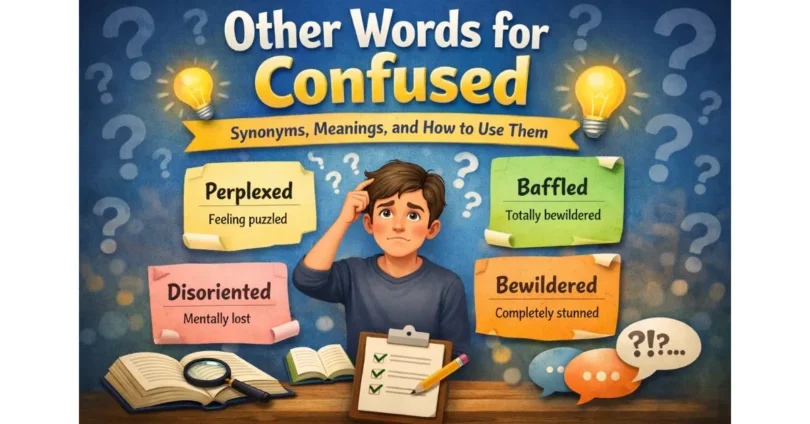

We’ve all felt confused at some point. Maybe you misread instructions, got lost in a new place, or just couldn’t understand a tricky situation. Sometimes, just saying “I’m confused” doesn’t fully explain how you feel. That’s why knowing other words for confused can make your writing and conversations clearer, more precise, and even more interesting.
In this article, we’ll explore different words and phrases you can use instead of “confused.” You’ll learn when to use each one, what they really mean, and examples to help you understand them. Whether you want to describe being mentally puzzled, emotionally flustered, or something messy and disorganized, this guide will give you the right words for every situation.
By the end, you’ll not only have a long list of synonyms but also know how to use them naturally in sentences, stories, or everyday conversations. Let’s make confusion easy to explain!
Understanding “Confused” in Depth
The word confused can describe several states or situations. Understanding these nuances helps you select the most accurate synonym.
Mental confusion – Feeling bewildered, unable to think clearly, or unsure about what is happening.
- Example: After reading the complex contract, he felt confused about his obligations.
Disorder or messiness – Something physically or structurally out of order.
- Example: The desk was in a confused jumble of papers and stationery.
Mistaken identity or interpretation – Confusing one thing with another.
- Example: Many people confuse coincidence with causation.
Emotional uncertainty – Feeling flustered, embarrassed, or upset.
- Example: She was confused by his unexpected criticism.
Complication or obscurity – When something is unclear or difficult to understand.
- Example: The report’s findings were confusing, leaving readers unsure of the conclusions.
Recognizing these contexts will help you pick synonyms that accurately reflect the type of confusion.
May be you like it:
Words That Rhyme With Confusing: Complete Guide
Words Often Confused Worksheet: Learn, Practice, and Master English
Writing Tips First Person POV Using “I” a Lot – Complete Guide
Why Use Synonyms for Confused?
Using synonyms for confused is not just about variety. It helps to:
- Communicate subtle differences in meaning
- Avoid repetitive language
- Enhance clarity and precision
- Make your writing more engaging and professional
For example, “bewildered” implies deep mental confusion, while “jumbled” describes a messy or disorganized state. Understanding the difference allows your writing to convey the intended nuance.
Other Words for Confused: Organized by Context
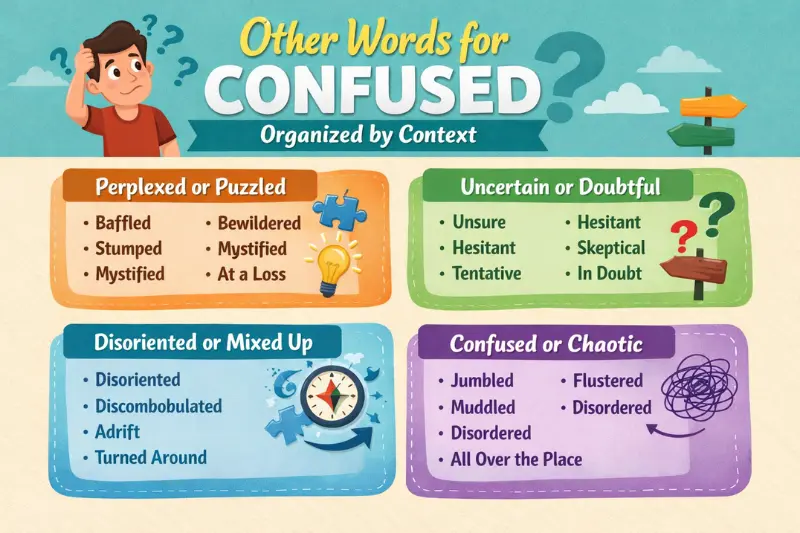
We’ve grouped synonyms by meaning and context so you can easily select the right word.
Mentally Bewildered
These words express a state of mental uncertainty or puzzlement.
Bewildered – Completely puzzled, often by something unexpected.
- Example: She was bewildered when she discovered the hidden room.
Perplexed – Confused in a thoughtful or analytical way.
- Example: He looked perplexed by the complex instructions.
Dazed – Shocked or stunned, unable to think clearly.
- Example: The sudden news left him dazed and silent.
Stupefied – Amazed or astonished to the point of confusion.
- Example: She was stupefied when she saw the final exam questions.
Bemused – Lost in thought, puzzled, often with a hint of amusement.
- Example: He was bemused by the strange conversation at the dinner table.
Tip: These words are best for describing internal mental states rather than physical messiness.
Disorganized or Messy
Sometimes confusion is external-referring to disorder, clutter, or chaos.
Jumbled – Mixed together in a messy or disorganized way.
- Example: The letters were jumbled in the envelope, making it hard to read.
Disordered – Lacking proper arrangement or organization.
- Example: His notes were disordered, making study time inefficient.
Cluttered – Filled with disorder, often physical objects.
- Example: The workshop was cluttered with tools and materials.
Chaotic – Complete confusion or tumult; total disorder.
- Example: The traffic during rush hour was chaotic.
Scrambled – Mixed up in a haphazard or confusing way.
- Example: Her thoughts were scrambled after the heated argument.
Tip: Use these words to describe external confusion, like messy spaces, disorganized materials, or situations.
Mistaken or Misidentified
Sometimes confusion happens because things are misunderstood or misidentified.
Conflated – Confusing two things as one.
- Example: He conflated the two theories, causing misunderstandings in the discussion.
Misguided – Confused in judgment; acting based on error.
- Example: The decision was well-intentioned but misguided.
Misinterpreted – Understood incorrectly.
- Example: Her comments were misinterpreted, creating unnecessary tension.
Mixed up – Confused about order, facts, or identity.
- Example: He mixed up the names of the new team members.
Tip: These words are useful when describing confusion caused by error or misunderstanding.
Emotionally Flustered or Upset
Confusion often comes with emotional reactions like embarrassment, anxiety, or nervousness.
Flustered – Nervously confused, often due to pressure or surprise.
- Example: She became flustered when asked an unexpected question.
Rattled – Upset or thrown off balance.
- Example: He was rattled by the sudden criticism.
Nonplussed – Unsure how to react; perplexed and slightly embarrassed.
- Example: He was nonplussed by the unexpected compliment.
Abashed – Embarrassed and confused, usually socially.
- Example: She was abashed after tripping in front of the audience.
Distraught – Deeply upset, often confused by emotional turmoil.
- Example: He was distraught when his plans fell apart.
Tip: These words capture emotional dimensions of confusion, making them ideal for narratives or descriptive writing.
Complicated or Unclear
Some confusion arises from complexity or lack of clarity.
Muddled – Confused and disorganized, often mentally or in presentation.
- Example: His explanation was so muddled that no one understood the point.
Obscure – Difficult to understand; unclear.
- Example: The legal terms were obscure to the general public.
Perplexing – Causing confusion or difficulty.
- Example: The instructions were perplexing even for experts.
Byzantine – Extremely complex or intricate.
- Example: The organizational structure was so byzantine that new employees were immediately confused.
Labyrinthine – Like a maze; extremely complicated.
- Example: The city streets were labyrinthine, leaving tourists confused.
Tip: Ideal for intellectual or structural confusion, such as complicated procedures, instructions, or theories.
Informal or Idiomatic Expressions
English has many idioms that convey confusion naturally.
At sea – Completely lost or unsure.
- Example: I was at sea trying to understand the new software.
Out of it – Not aware or not understanding.
- Example: He seemed out of it after staying up all night.
Thrown off – Surprised or disoriented.
- Example: She was thrown off by the unexpected schedule change.
All over the place – Mentally scattered or disorganized.
- Example: His thoughts were all over the place during the meeting.
In a fog – Confused and unclear in thought.
- Example: He was in a fog after waking up too early.
How to Choose the Right Word

Identify the type of confusion – Is it mental, emotional, structural, or mistaken?
Consider formality – Words like “bewildered” are formal, while “mixed up” is casual.
Use context clues – Look at the surrounding text or situation to pick the synonym that fits best.
Combine with examples – A word is stronger when paired with a practical scenario.
May be you like it:
Tips For Writing Lyrics: A Complete Step-by-Step Guide
Tips for Writing Wedding Vows That Feel Real, Personal & Unforgettable
ACT Grammar Rules: The Complete Guide to Master ACT English
Examples in Context
Here are several short scenarios illustrating the right choice of synonyms:
- Mental confusion:
- After the lecture on quantum physics, Sarah felt perplexed by the complex theories.
- Messy/disorganized:
- The office was cluttered with files, making it hard to find anything.
- Mistaken understanding:
- Many people conflate correlation with causation, leading to incorrect conclusions.
- Emotional fluster:
- He was flustered when the boss called him out unexpectedly in the meeting.
- Complicated/unclear:
- The new software manual was labyrinthine, confusing even experienced users.
Additional Tips for Writers
- Avoid overuse – Don’t use “confused” repeatedly; rotate synonyms to maintain variety.
- Clarify when needed – Pair complex synonyms with examples to ensure comprehension.
- Match tone – Formal writing may benefit from words like “bemused” or “perplexed,” while casual writing works with “mixed up” or “at sea.”
- Engage the reader – Use idioms and scenarios to make abstract confusion relatable.
Quick Reference Table (Expanded)
| Context | Synonyms | Example |
|---|---|---|
| Mentally bewildered | Bewildered, Perplexed, Dazed, Stupefied, Bemused | He was dazed by the sudden announcement. |
| Messy/disorganized | Jumbled, Cluttered, Chaotic, Scrambled, Disordered | The room was in a chaotic mess after the party. |
| Mistaken | Conflated, Misguided, Misinterpreted, Mixed up | The story conflated two historical events. |
| Emotional fluster | Flustered, Rattled, Nonplussed, Abashed, Distraught | She was flustered when asked about her performance. |
| Complicated | Muddled, Obscure, Perplexing, Byzantine, Labyrinthine | The legal document was Byzantine and confusing. |
| Informal/idiomatic | At sea, Out of it, Thrown off, All over the place, In a fog | He was at sea when navigating the new software. |
FAQs About “Other Words for Confuse”
What does “confused” really mean?
It describes being puzzled, mentally unsure, or something that’s messy and hard to understand.
Why should I use synonyms for “confused”?
Synonyms help make your writing clearer, more precise, and less repetitive.
What are some common synonyms for confused?
Bewildered, puzzled, dazed, flustered, jumbled, perplexed, and mixed up.
Are there words for emotional confusion?
Yes! Words like flustered, rattled, abashed, and distraught describe emotional confusion.
What words describe messy or disorganized situations?
Cluttered, chaotic, jumbled, scrambled, and disordered work well for messy situations.
How do I choose the right synonym?
Think about the type of confusion: mental, emotional, messy, or mistaken. Match your word to the situation.
Can idioms be used instead of “confused”?
Absolutely! Idioms like “at sea,” “out of it,” or “all over the place” add a natural, conversational touch.
Are some synonyms formal and others casual?
Yes. Words like bewildered or perplexed are formal, while mixed up or flustered are more casual.
How can I use these words in writing?
Pair synonyms with examples or situations to make your meaning clear and engaging.
Is “confused” always negative?
Not always. Some synonyms, like bemused or puzzled, can be neutral or even slightly positive in tone.
Conclusion
Knowing other words for confused allows you to communicate clearly and add variety to your writing. By considering context-mental, emotional, structural, or mistaken-you can pick the synonym that conveys the exact nuance you want.
Remember: clarity is key. Use examples, idioms, and scenario-based descriptions to make your writing relatable, engaging, and precise.
This guide provides practical, user-friendly, and comprehensive insight into expressing confusion naturally in any context.
May be you like it:
SEO Agency in Australia UploadArticle: The Complete Guide to Choosing the Right Partner in 2026
The Ultimate Guide to UploadArticle: Boost Your SEO & Reach More Readers
UploadArticle Relationship: The Complete Strategy to Get Published, Approved & Ranked