
Strong grammar is not just about correctness. It builds credibility, improves clarity, and increases professional trust. In today’s corporate world, effective business communication depends on clear grammar, professional tone, and structured writing.
Whether you write emails, reports, proposals, or Slack messages, understanding business communication grammar rules helps you sound confident and competent.
This guide covers practical rules, modern workplace scenarios, tone control strategies, and real business examples that most competitors miss.
Table of Contents
Why Grammar Matters in Business Communication
Poor grammar can:
- Damage professional reputation
- Create misunderstandings
- Reduce leadership credibility
- Affect promotions and career growth
Clear grammar helps you:
- Communicate ideas confidently
- Sound professional in emails
- Build strong client relationships
- Improve workplace communication skills
Core Business Communication Grammar Rules
May be you like it:
Words That Rhyme With Confusing: Complete Guide
Words Often Confused Worksheet: Learn, Practice, and Master English
Writing Tips First Person POV Using “I” a Lot – Complete Guide
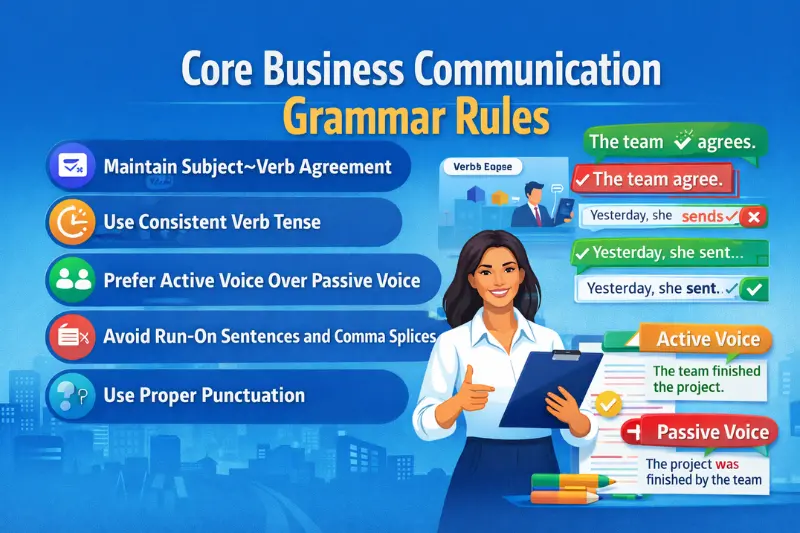
1. Maintain Subject–Verb Agreement
Your subject and verb must match in number.
✔ The manager approves the proposal.
✔ The managers approve the proposal.
Incorrect agreement creates confusion and looks unprofessional.
2. Use Consistent Verb Tense
Avoid switching tenses within the same idea.
❌ Yesterday, she completed the report and sends it to the team.
✔ Yesterday, she completed the report and sent it to the team.
Choose the correct time frame (past, present, future) and stay consistent.
3. Prefer Active Voice Over Passive Voice
Active voice sounds direct and confident.
❌ The project was completed by the team.
✔ The team completed the project.
Use passive voice only when the action matters more than the subject.
4. Avoid Run-On Sentences and Comma Splices
Break long ideas into clear sentences.
❌ The client called we were not available.
✔ The client called, but we were not available.
5. Use Proper Punctuation
Correct punctuation improves readability:
- Use commas for clarity.
- Use semicolons to connect related ideas.
- Avoid excessive exclamation marks.
- Do not overuse capital letters.
Professional writing should look clean and structured.
Business Email Grammar Rules
Email writing requires clarity and structure.
Email Structure Checklist
- Clear subject line
- Professional greeting
- Short paragraphs
- Direct message
- Clear call to action
- Professional signature
Polite and Professional Tone Examples
❌ Send the file today.
✔ Please send the file by 3 PM today.
❌ You made a mistake.
✔ There appears to be a small error in the document.
Tone control is one of the most important business communication grammar rules that competitors rarely explain properly.
May be you like it:
Tips For Writing Lyrics: A Complete Step-by-Step Guide
Tips for Writing Wedding Vows That Feel Real, Personal & Unforgettable
ACT Grammar Rules: The Complete Guide to Master ACT English
Modal Verbs for Professional Communication
Modal verbs help you sound polite and professional.
| Purpose | Example |
|---|---|
| Request | Could you review this report? |
| Suggest | We should consider a new strategy. |
| Permission | May I schedule a meeting? |
| Possibility | This plan might increase revenue. |
| Obligation | We must meet the deadline. |
Using modal verbs improves workplace communication and reduces directness that may sound aggressive.
Grammar Rules for Business Reports
Professional reports require formal structure and clarity.
Key Report Writing Rules
- Use past tense when describing results.
- Avoid first-person language unless necessary.
- Use bullet points for data presentation.
- Maintain parallel structure in lists.
- Include headings and subheadings.
Example of parallel structure:
✔ The strategy is clear, actionable, and measurable.
Modern Workplace Grammar Rules (New Section Competitors Miss)
Today’s business communication includes:
- Remote work emails
- Slack messages
- LinkedIn communication
- Virtual meeting summaries
Slack and Instant Messaging Rules
- Avoid slang in professional channels.
- Use full sentences for important instructions.
- Clarify deadlines clearly.
- Avoid one-word replies in formal discussions.
LinkedIn Professional Writing Tips
- Use formal grammar.
- Avoid excessive emojis.
- Write in short paragraphs.
- Proofread before posting.
Modern digital communication still requires professional grammar standards.
Common Workplace Grammar Mistakes to Avoid
Homophones
- Their / There / They’re
- Your / You’re
- Affect / Effect
Misplaced Modifiers
❌ After reviewing the report, the mistake was obvious.
✔ After reviewing the report, we noticed the mistake.
Overusing “Kindly”
Instead of: Kindly revert back soon.
Use: Please respond at your earliest convenience.
Overly Long Sentences
Break complex ideas into shorter, digestible sentences.
Business Tone and Clarity Strategies
Grammar alone is not enough. Professional communication also requires:
- Confidence without aggression
- Clarity without being abrupt
- Politeness without weakness
How to Disagree Professionally
❌ I disagree with this plan.
✔ I understand your perspective; however, we may need to explore alternative options.
This human-centered communication approach improves collaboration and leadership presence.
Quick Business Grammar Checklist
Before sending any professional message, ask:
✔ Is the verb tense consistent?
✔ Is subject-verb agreement correct?
✔ Is the tone polite and professional?
✔ Are sentences clear and concise?
✔ Did I proofread for spelling errors?
✔ Is the message structured properly?
This 30-second review improves writing quality significantly.
Human Touch: Why This Really Matters
In business, people judge competence through communication. Clear grammar signals attention to detail, respect for the reader, and leadership potential.
You do not need perfect English. You need clear, confident, and professional communication.
Strong grammar builds trust. Trust builds opportunity.
FAQs
What are business communication grammar rules?
Business communication grammar rules are guidelines that ensure professional, clear, and accurate writing in emails, reports, and workplace messages.
Why is grammar important in business communication?
Grammar improves clarity, builds credibility, prevents misunderstandings, and helps professionals maintain a strong reputation.
What is the most important grammar rule in business writing?
Subject–verb agreement and consistent verb tense are the most important rules for clear and professional communication.
Should I use active or passive voice in business emails?
You should usually use active voice because it sounds direct, confident, and professional.
How can I sound more polite in business communication?
Use modal verbs like “could,” “would,” and “may,” and avoid overly direct or aggressive language.
What common grammar mistakes should I avoid at work?
Avoid run-on sentences, homophone errors, incorrect verb tense, misplaced modifiers, and overly long sentences.
How can I improve my business writing skills?
Practice daily writing, proofread carefully, use grammar tools, and follow a professional email structure.
Do grammar mistakes affect career growth?
Yes, frequent grammar mistakes can harm your credibility and reduce professional opportunities.
Conclusion
Mastering business communication grammar rules is one of the smartest investments you can make in your professional growth. Clear grammar improves workplace communication, strengthens leadership presence, and builds trust with colleagues and clients.
When you apply subject–verb agreement, consistent verb tense, active voice, proper punctuation, and professional tone strategies, your emails become clearer, your reports sound stronger, and your messages carry more authority.
In today’s digital workplace-whether you are writing emails, drafting reports, sending Slack messages, or posting on LinkedIn-strong grammar is not optional. It is a competitive advantage.
You do not need perfect English. You need clear, confident, and structured communication.
Refine your grammar. Elevate your professionalism. Strengthen your career.
May be you like it:
SEO Agency in Australia UploadArticle: The Complete Guide to Choosing the Right Partner in 2026
The Ultimate Guide to UploadArticle: Boost Your SEO & Reach More Readers
UploadArticle Relationship: The Complete Strategy to Get Published, Approved & Ranked