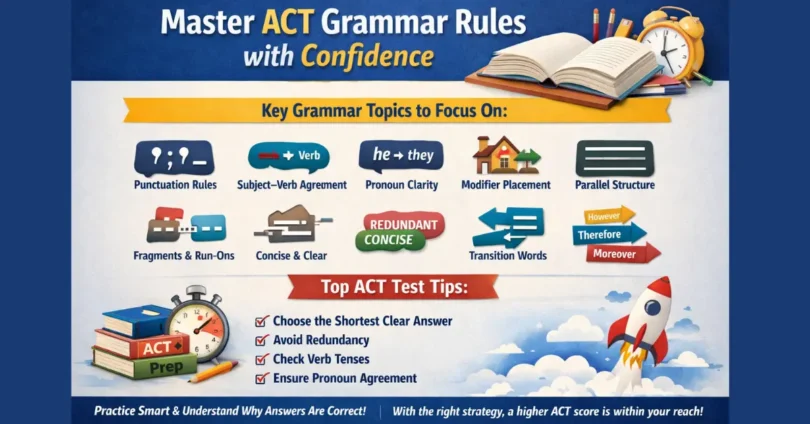

If you want a higher ACT English score, you must master the core ACT grammar rules. The good news? The ACT tests the same patterns repeatedly.
This guide breaks down every major ACT English rule in a simple, strategic, and easy-to-scan format – plus exam-day shortcuts your competitors won’t tell you.
Why ACT Grammar Rules Matter
The ACT English section:
- Contains 75 questions
- Must be completed in 45 minutes
- Tests grammar, punctuation, style, and rhetorical skills
- Repeats the same rule patterns year after year
Once you understand the most tested rules, your score improves quickly.
Table of Contents
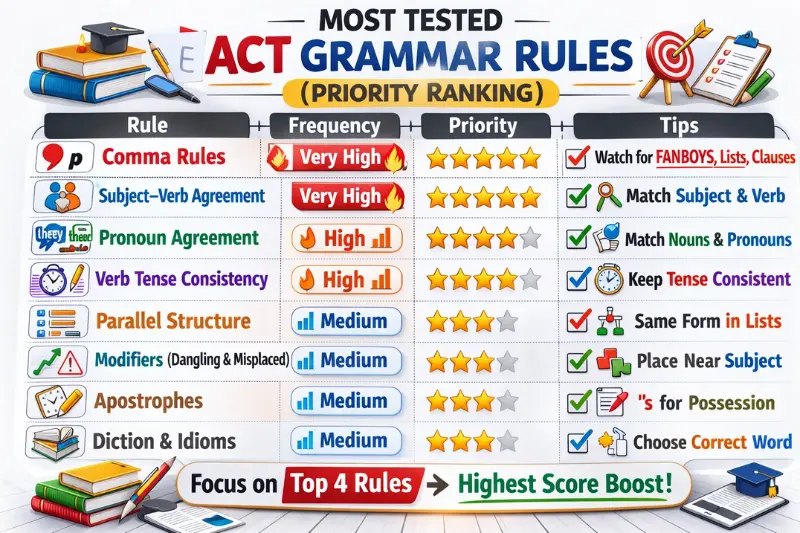
Most Tested ACT Grammar Rules (Priority Ranking)
May be you like it:
Words That Rhyme With Confusing: Complete Guide
Words Often Confused Worksheet: Learn, Practice, and Master English
Writing Tips First Person POV Using “I” a Lot – Complete Guide
1. Comma Rules (Most Tested on ACT)
Use commas:
Before FANBOYS joining two full sentences
(for, and, nor, but, or, yet, so)
London is old, but it has modern areas.
After introductory clauses
Because it is old, London attracts tourists.
Around non-essential information
London, which is very old, attracts tourists.
Between items in a list
Museums, parks, and galleries
Do NOT use commas:
Between subject and verb
The city of London, is historic.
Between two complete sentences (comma splice)
London is old, it is beautiful.
Before or after “that”
The book, that I read, was helpful.
ACT Shortcut
If you see:
Comma + pronoun (it, they, he, she)
→ It is probably wrong.
2. Semicolons, Colons & Dashes
Semicolon = Period
Use a semicolon between two complete sentences.
London is old; it attracts tourists.
Colon Rule
A colon must follow a complete sentence.
London has many attractions: museums and parks.
Dashes
Used like commas (non-essential info) or colons (lists).
London-which is very old-attracts tourists.
3. Subject-Verb Agreement
Singular subject → singular verb
Plural subject → plural verb
The city is large.
The cities are large.
Watch Out for Traps
Prepositional phrases confuse students:
The list of items are long.
The list of items is long.
ACT Tip
Ignore extra phrases and find the real subject.
4. Pronoun Agreement
Pronouns must match the noun in number.
Students must bring their pencils.
The student must bring his or her pencil.
Common Errors
- its vs. it’s
- their vs. there vs. they’re
- who vs. whom
Quick Trick
Whom → after a preposition
To whom it may concern
Who → before a verb
Who is coming?
5. Verb Tense Rules
Keep tense consistent.
She walked to school and eats lunch.
She walked to school and ate lunch.
Present Perfect
Use with “for” or “since.”
They have lived here for years.
Past Perfect
Use with “by the time.”
By the time she arrived, the class had started.
6. Parallel Structure
Keep lists in the same format.
She likes running, to swim, and biking.
She likes running, swimming, and biking.
Word Pairs
- Either…or
- Neither…nor
- Not only…but also
- More…than
Both sides must match.
May be you like it:
Tips For Writing Lyrics: A Complete Step-by-Step Guide
Tips for Writing Wedding Vows That Feel Real, Personal & Unforgettable
Words From Confuse – 40+ Anagrams You Can Make
7. Modifiers (Dangling & Misplaced)
Modifier must clearly describe the subject.
Running down the street, the backpack fell.
Running down the street, she dropped her backpack.
8. Apostrophes
Singular possessive → add ’s
The dog’s leash
Plural possessive → s’
The dogs’ leashes
No apostrophe = plural only
9. Diction & Idioms
ACT tests correct word usage.
Interested in
Capable of
Different from
No grammar rule helps here – trust what sounds correct.
Restrictive vs. Nonrestrictive Clauses
This is heavily tested and often misunderstood.
Restrictive (essential) → no commas
The students who studied passed.
Nonrestrictive (extra info) → commas
The students, who studied all night, passed.
If removing the clause changes the meaning, do NOT use commas.
ACT English Strategy You Won’t Find Elsewhere
Shorter Is Usually Better
If two answers mean the same thing → choose the shorter one.
Eliminate Redundancy
Large in size
Large
Read the Full Sentence
Never answer based only on the underlined portion.
Identify the Question Type First
Ask yourself:
- Is this punctuation?
- Agreement?
- Verb tense?
- Word choice?
Then apply the correct rule.
Mini Practice Quiz
- The group of students are studying for the exam.
A) NO CHANGE
B) is studying
C) were studying
D) have studied
Answer: B
- She enjoys reading, to swim, and biking.
A) NO CHANGE
B) swimming
C) swim
D) to swimming
Answer: B
Final Exam-Day Checklist
Before submitting answers, check:
- Does the verb match the subject?
- Are commas used correctly?
- Is tense consistent?
- Is the structure parallel?
- Is the sentence concise?
Conclusion:
Mastering ACT grammar rules is not about memorizing endless definitions – it is about understanding patterns, spotting common traps, and applying clear, logical rules under time pressure.
To recap, you should focus on:
- Punctuation rules (commas, semicolons, colons, dashes)
- Subject–verb agreement
- Pronoun clarity and agreement
- Modifier placement
- Parallel structure
- Sentence boundaries (fragments & run-ons)
- Conciseness and redundancy elimination
- Transition words and logical flow
The ACT English section rewards students who:
- Choose the shortest clear answer
- Eliminate redundancy
- Check verb tense consistency
- Ensure every pronoun has a clear noun
- Read the entire sentence for meaning
Unlike many test guides that simply list rules, the real advantage comes from understanding why answers are correct, practicing strategically, and recognizing patterns the test repeats year after year.
If you consistently review high-frequency ACT grammar rules, practice with timed drills, and analyze your mistakes, your score will improve. Grammar on the ACT is predictable – and that means it’s beatable.
Stay focused, practice smart, and treat every question as a logic puzzle. With the right strategy, a higher ACT English score is absolutely within reach.
May be you like it:
SEO Agency in Australia UploadArticle: The Complete Guide to Choosing the Right Partner in 2026
The Ultimate Guide to UploadArticle: Boost Your SEO & Reach More Readers
UploadArticle Relationship: The Complete Strategy to Get Published, Approved & Ranked