
Table of Contents
Tips for Writing Vows That Actually Sound Like You
Writing your wedding vows is one of the most personal things you will ever do. You are standing in front of the person you love most and saying, out loud, exactly what they mean to you and what you promise to give them for the rest of your life.
No pressure, right?
The good news: you do not need to be a writer. You do not need elegant prose or a gift for poetry. You just need a little structure, a few honest thoughts, and the tips below to get out of your head and onto the page.
Here is everything you need to know, from the first blank page to the moment you read those words at the altar.
Why Personal Vows Are Worth the Effort
Most couples say their vows are the part of the wedding they remember most vividly. Not the flowers, not the food, and not even the dress. The words.
When you write your own vows, you tell your specific story. You name the exact moment you knew. You describe the real quirks you love. You make promises that are actually yours to keep. Guests feel that difference immediately, and so does your partner.
If you have ever been to a wedding and found yourself unexpectedly crying, there is a good chance it was because the vows were specific and honest. That is the target to aim for.
Before You Write a Single Word
Know the Format Your Ceremony Requires
Before you start writing, check in with your officiant. Some ceremonies have legal wording that must be included. Some religious ceremonies have set vow scripts you build on rather than replace. Others give you total creative freedom.
Knowing your boundaries before you write saves you from having to cut content you love later.
May be you like it:
SEO Agency in Australia UploadArticle: The Complete Guide to Choosing the Right Partner in 2026
UploadArticle Relationship: The Complete Strategy to Get Published, Approved & Ranked
Decide on a Rough Length Together
You and your partner do not need to match each other word for word, but agreeing on a general length beforehand saves one person from reading for four minutes while the other finishes in 45 seconds.
A good target: 1 to 2 minutes of speaking time. That is roughly 150 to 300 words. Short enough to stay focused, long enough to say something real.
Agree on a ballpark, then write independently. Your vows do not need to sound the same. You are two different people, and that contrast is actually beautiful.
Give Yourself Enough Time
Start writing 4 to 6 weeks before your wedding. Not because vows take that long to write, but because your first draft will not be your best draft, and you want time to let ideas settle.
Write a messy first draft. Walk away. Come back. What felt forced will reveal itself, and what felt right will still feel right.
The Structure That Works
Vows are not love letters. A love letter is a declaration of feeling. A vow is a promise. The strongest vows do both: they establish the feeling, then commit to action.
Use this simple four-part structure as a starting point:
- Who this person is to you. One or two sentences. Not a list of adjectives, but a specific observation: “You are the only person I have ever wanted to call at the end of a bad day.”
- A specific memory or moment. Name the moment you knew. Include real details: the place, what was said, how it felt. Specificity is what separates a vow from a greeting card.
- What you love about them. Choose two or three things. Not their eyes or their smile. The real things: how they handle hard news, how they make strangers feel at ease, how they remember small things you mentioned once six months ago.
- Your promises. This is the heart of the vow. Make them real and keepable. A mix of meaningful and personal works well: “I promise to be patient when you need quiet, to show up when it is hard, and to always make the coffee before I make any demands of your morning.”
The Specificity Trick: The Single Biggest Upgrade You Can Make
Nearly every piece of advice about vows says “be specific.” What most of those articles do not tell you is how.
Specificity is not just about naming a place or a date. It is about sensory detail, the small true things that only the two of you would recognize.
Compare these two versions:
Generic: “I knew I loved you when we were on our road trip and everything felt right.”
Specific: “I knew I loved you when the car broke down outside of Flagstaff, you laughed instead of panicking, and then spent an hour on the phone with a mechanic you could barely understand. I thought: I want that beside me for everything that goes wrong.”
The second version does the same job in the same amount of space. But it lands completely differently because it is true and it is yours.
To get there, try answering these prompts in writing before you draft your vows:
- What is the smallest thing they do that you would miss if it disappeared tomorrow?
- When was a moment they surprised you, in the best possible way?
- What do you now do, say, or see differently because of them?
- What are you most afraid of getting wrong in this marriage, and what do you want to promise about that?
- If you had to describe your relationship in one scene, not a feeling but an actual scene, what would it be?
These prompts do not have to produce finished vow content. They are ways to find the honest detail you will then shape into something cleaner.
What to Avoid
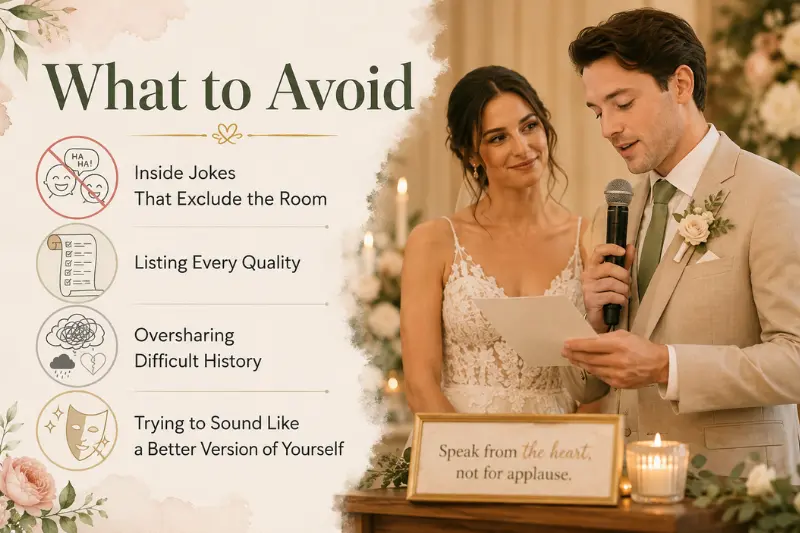
Inside Jokes That Exclude the Room
A small reference that only the two of you understand can be charming. A string of inside jokes leaves guests completely disconnected from the moment. The people watching you want to understand your love. Give them enough to feel it.
Listing Every Quality
“You are kind, funny, patient, generous, warm, thoughtful, and the most supportive person I have ever met.” This sounds like a performance review. Pick the two or three things that are most true and most specific, and explain why those things matter to you.
Oversharing Difficult History
Vows can and should be real. Mentioning that you have been through hard times is powerful. Detailing the specifics of those hard times in public is a different thing. Use your judgment. If it would feel uncomfortable to say in front of your parents and your closest friends at the same time, it probably belongs in a private letter instead.
Trying to Sound Like a Better Version of Yourself
The most common vow mistake is writing in a voice you think you should have instead of the voice you actually have. If you never use the word “traverse” in conversation, do not use it in your vows. Over-editing removes the thing that makes vows work, which is the fact that they sound like you.
How to Handle the Blank Page
If you sit down to write and nothing comes out, do not stare at the cursor. Try this instead:
The voice memo method. Set your phone to record and pretend you are telling a friend about your partner. Talk for five minutes without stopping. Then listen back and write down any sentence that sounds real. You will find more usable material than you expect.
The prompts method. Use the questions above. Write single-sentence answers first. Do not worry about order or flow. You are mining for material, not writing a draft.
The letter method. Write your partner a letter you will never send. Tell them everything. Then, once it is out, go back and find the two or three most important things you said. Those become the core of your vows.
The goal is to get words on a page, any words, so your brain stops treating the blank page as a creative emergency.
Getting Feedback Without Ruining the Surprise
If you want a second opinion on your vows but you and your partner are keeping them a surprise, ask one trusted person, such as a bridesmaid, a close friend, or a sibling, to read them. Give them one question to answer: “Does this sound like me?“
You are not looking for a writing critique. You are checking that the vows actually read the way you intended. A single reader who knows you well is all you need.
Reading Your Vows Out Loud: Delivery Tips
The best vows in the world do not land if they are rushed or swallowed. Delivery matters.
Practice More Than You Think You Need To
Read your vows out loud at least ten times before the wedding. Your mouth needs to know the words well enough that your brain can stay present while you say them.
Slow Down, Especially at the Start
Nerves speed everything up. When you stand at the altar, take one full breath before you start. Read slower than feels natural. If you slow down when emotion hits, that is fine, that is human, and it will be one of the most genuine moments of the day.
Plan for Tears
Pause. Breathe. Let it happen. No one at your wedding is going to think less of you for crying. Take a sip of water if one is available. If you know you cry easily, write your vows in slightly larger font so you can find your place quickly when your eyes are blurry.
Use a Card, Not Your Phone
A printed card feels ceremonial and removes the risk of a low battery or a locked screen at the worst possible moment. Write or print your vows in a font size you can read easily without squinting: 14 to 16 point is a safe range. Give a copy to your officiant as a backup.
May be you like it:
Tips For Writing Lyrics: A Complete Step-by-Step Guide
ACT Grammar Rules: The Complete Guide to Master ACT English
A Note on Humor
Humor in vows works when it is true, not when it is performed. A genuine reference to a real quirk or a shared running joke lands because it is specific. Generic humor, or humor that exists just to get a laugh, usually falls flat in a ceremony setting.
The rule of thumb: if the funny thing is also a loving thing, it belongs in your vows. If it is just a joke, save it for the reception speech.
Vow Checklist Before the Big Day
Before your wedding, make sure you can check off each of these:
- Your vows are within your agreed length
- You have read them aloud at least ten times
- They are printed in a readable font on a card you will carry
- Your officiant has a backup copy
- You have removed anything you are not comfortable saying in public
- They sound like you, not a polished version of you
Final Thought
The best vows are not the most beautifully written ones. They are the most honest ones. They are the vows that make your partner feel seen, that give your guests a window into your relationship, and that you will still mean on your worst day as much as your best.
Write the truth. Say it simply. The rest takes care of itself.
May be you like it:
Words That Rhyme With Confusing: Complete Guide
Words Often Confused Worksheet: Learn, Practice, and Master English
Writing Tips First Person POV Using “I” a Lot – Complete Guide