
Introduction
Do you ever get confused between words like their, there, and they’re? You’re not alone. Many people struggle with words that look or sound similar but have different meanings. These small mistakes can make your writing unclear or even change the meaning of a sentence.
That’s where a commonly confused words worksheet can really help. It gives you simple exercises to practice the right words in the right places. Instead of just memorizing rules, you learn by doing – which makes it easier to remember.
In this guide, you’ll find easy explanations, helpful examples, and ready-to-use worksheets with answers. Whether you’re a student, teacher, or just someone who wants to improve their English, this resource will help you build confidence and avoid common mistakes in everyday writing.
Table of Contents
What Are Commonly Confused Words?
Commonly confused words are words that look similar, sound alike, or have related meanings – but are used differently in sentences. Because they are so alike, people often mix them up while writing or speaking.
These words can create confusion and lead to small mistakes that affect the clarity of your message.
Simple Examples:
Their / There / They’re
- Their shows ownership
- There refers to a place
- They’re means “they are”
To / Too / Two
- To shows direction
- Too means “also” or “very”
- Two is a number
Your / You’re
- Your shows possession
- You’re means “you are”
- Why They Matter
Using the wrong word can:
- Change the meaning of your sentence
- Make your writing look unprofessional
- Cause confusion for the reader
For example:
- Your going to love this.
- You’re going to love this.
Even though the mistake is small, it makes a big difference.
In Simple Words
Commonly confused words are tricky words that seem similar but must be used carefully. Learning them helps you write clearly, correctly, and confidently.
Why Do People Confuse These Words?
Many commonly confused words seem almost the same, so it’s completely normal to mix them up. Understanding why this happens can help you avoid these mistakes more easily.
Similar Sounds (Homophones)
Some words sound exactly the same when spoken, even though they have different meanings and spellings.
Example:
- Their / There / They’re
When you hear them, they sound identical – so it’s easy to choose the wrong one while writing.
Similar Spelling
Some words look very similar, which can confuse your brain, especially when you’re writing quickly.
Example:
- Lose vs Loose
A small difference in spelling can completely change the meaning.
Fast Typing or Careless Writing
When people write quickly (especially on phones or laptops), they often don’t notice small mistakes.
Example:
- Writing your instead of you’re
Weak Understanding of Grammar Rules
Sometimes people haven’t fully learned the difference between certain words, so they guess instead of applying a rule.
Relying Too Much on Spell Check
Spell check tools can catch spelling errors, but they often miss word usage mistakes.
Example:
- Their going to the park
- (Spell check may not flag this as wrong)
Lack of Practice
Like any skill, using the correct words takes practice. Without regular practice, it’s easy to forget the correct usage.
In Simple Words
People confuse these words because they look alike, sound alike, or are used in similar situations. The good news is that with a little practice and the right worksheets, you can quickly learn the difference and avoid these mistakes.
May be you like it:
SEO Agency in Australia UploadArticle: The Complete Guide to Choosing the Right Partner in 2026
UploadArticle Relationship: The Complete Strategy to Get Published, Approved & Ranked
Commonly Confused Words List (With Easy Examples)
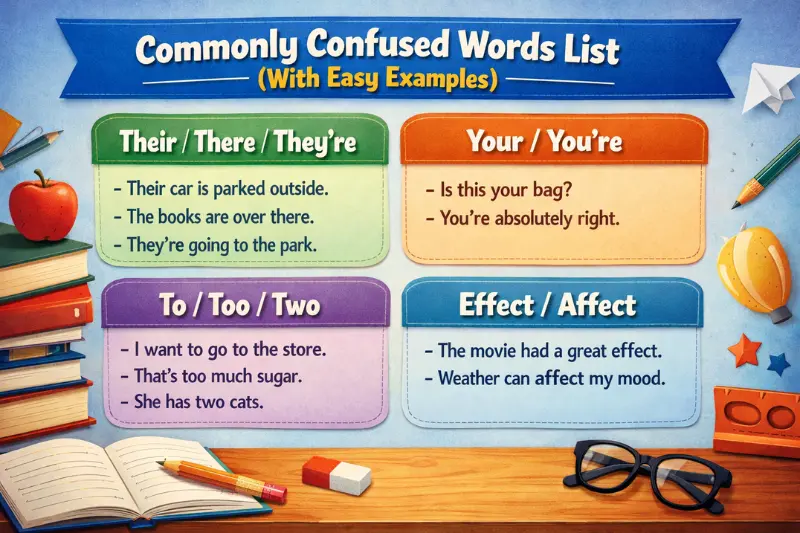
Learning commonly confused words becomes much easier when you see simple meanings, clear examples, and quick tips together. Below is a helpful list of the most important word pairs you should know.
Their vs There vs They’re
- Their → shows ownership
- There → refers to a place
- They’re → means they are
Example:
- Their car is parked over there. They’re coming soon.
Tip: If you can say they are, use they’re.
To vs Too vs Two
- To → shows direction or purpose
- Too → means also or very
- Two → a number
Example:
- I want to go too, but I only have two tickets.
Tip: Too has an extra “o” – think of it as “extra” meaning also.
Your vs You’re
- Your → shows possession
- You’re → means you are
Example:
- You’re doing a great job with your work.
Tip: Replace with you are to check.
Its vs It’s
- Its → shows possession
- It’s → means it is
Example:
- It’s a beautiful day, and the cat is playing with its toy.
Tip: Apostrophe = it is
Then vs Than
- Then → relates to time
- Than → used for comparison
Example:
- Finish your work, then relax.
- She is taller than her brother.
Affect vs Effect
- Affect → action (verb)
- Effect → result (noun)
Example:
- Lack of sleep can affect your health.
- The effect of the medicine was quick.
Tip: Affect = Action
Lose vs Loose
- Lose → to misplace or fail to win
- Loose → not tight
Example:
- Don’t lose your keys.
- These shoes are too loose.
Accept vs Except
- Accept → to receive
- Except → excluding something
Example:
- I accept your apology.
- Everyone came except Ali.
Farther vs Further
- Farther → physical distance
- Further → figurative or additional
Example:
- The shop is farther down the road.
- We need further discussion.
Who vs Whom
- Who → subject of a sentence
- Whom → object of a sentence
Example:
- Who is calling?
- Whom did you invite?
Tip:
- Use he/she → who
- Use him/her → whom
Quick Summary Table
| Word Pair | Meaning Difference |
|---|---|
| Their / There / They’re | Ownership / Place / They are |
| To / Too / Two | Direction / Also / Number |
| Your / You’re | Possession / You are |
| Its / It’s | Possession / It is |
| Then / Than | Time / Comparison |
| Affect / Effect | Action / Result |
| Lose / Loose | Misplace / Not tight |
| Accept / Except | Receive / Exclude |
In Simple Words
These commonly confused words may look small, but they make a big difference in your writing. Learning them with examples and tips will help you avoid mistakes and write with confidence.
Intermediate Worksheet (Level 2)
This level is perfect for students who already understand the basics and want to improve accuracy and confidence. Read each sentence carefully and choose the correct word based on context.
Exercise 1: Choose the Correct Word
- The weather will __ our travel plans. (affect / effect)
- The new rule had a positive __ on students. (affect / effect)
- She is smarter __ her brother. (then / than)
- Finish your homework, __ you can watch TV. (then / than)
- Everyone went to the party __ Ahmed. (accept / except)
- I __ your invitation happily. (accept / except)
- The dog ran __ down the street. (farther / further)
- We need __ explanation before deciding. (farther / further)
Exercise 2: Fill in the Blanks
- This small mistake can _ your final grade. (affect / effect)
- He didn’t know _ to respond. (how / who)
- She walked __ than before. (farther / further)
- I will call you, and __ we will meet. (then / than)
Exercise 3: Sentence Correction
Correct the mistakes in the sentences below:
- This will have a bad affect on your health.
- She is better then me at English.
- I except your apology.
- We need farther information about this topic.
Answer Key
- Affect
- Effect
- Than
- Then
- Except
- Accept
- Farther
- Further
- Affect
- How
- Farther
- Then
Corrected Sentences:
- This will have a bad effect on your health.
- She is better than me at English.
- I accept your apology.
- We need further information about this topic.
Advanced Worksheet (Middle & High School)
This worksheet is designed for students who want to master commonly confused words at a higher level. These exercises focus on real-life writing, sentence correction, and deeper understanding of context.
Exercise 1: Choose the Correct Word
- The teacher asked __ completed the assignment. (who / whom)
- __ did you invite to the event? (who / whom)
- The company will __ new policies next year. (adopt / adapt)
- You must __ to the new environment quickly. (adopt / adapt)
- The dress is __ expensive for me. (to / too)
- He is going __ the store. (to / too)
- The team performed __ than expected. (better / best)
- This is the __ solution we have. (better / best)
Exercise 2: Fill in the Blanks
- Everyone brought their books __ Ali. (accept / except)
- She gave me __ advice on the project. (good / well)
- The results will __ your decision. (affect / effect)
- The new law had a strong __ on society. (affect / effect)
Exercise 3: Sentence Correction
Find and correct the mistake in each sentence:
- Your the best student in the class.
- Its important to finish your work on time.
- She is more smarter than her friend.
- I don’t know who to give this gift to. (Hint: check object pronoun)
- He did the work good.
- There going to announce the results soon.
Exercise 4: Rewrite for Clarity
Rewrite each sentence using the correct word:
- I have to books and I want too read them.
- Their going too the park over there.
- The weather had a big affect on our trip.
- Your going to need further help then this.
Answer Key
Exercise 1:
- Who
- Whom
- Adopt
- Adapt
- Too
- To
- Better
- Best
Exercise 2:
- Except
- Good
- Affect
- Effect
Exercise 3 (Corrected Sentences):
- You’re the best student in the class.
- It’s important to finish your work on time.
- She is smarter than her friend.
- I don’t know whom to give this gift to.
- He did the work well.
- They’re going to announce the results soon.
Exercise 4 (Rewritten Sentences):
- I have two books and I want to read them.
- They’re going to the park over there.
- The weather had a big effect on our trip.
- You’re going to need further help than this.
Printable Commonly Confused Words Worksheet (Free)
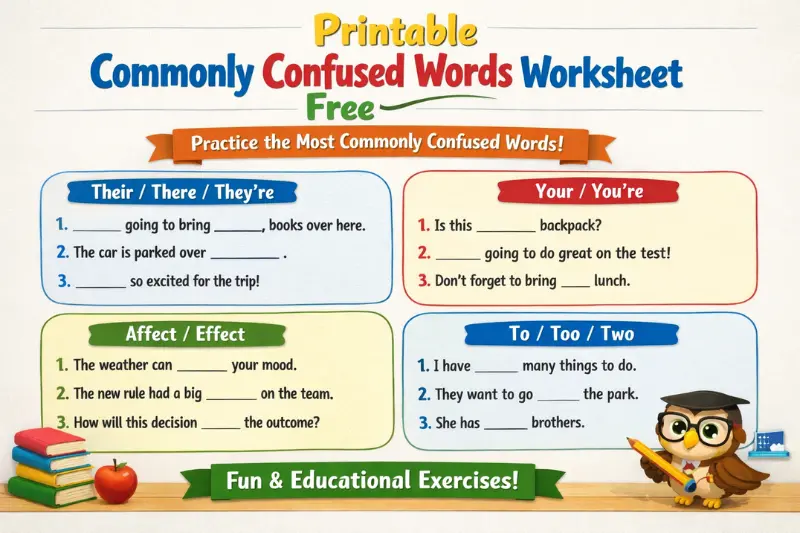
Here’s a ready-to-use printable worksheet for practicing commonly confused words. Perfect for students, teachers, or anyone who wants to improve their English. You can print it directly and start practicing today!
Part A: Choose the Correct Word
- She didn’t know __ to respond. (who / whom)
- The new rules will __ students’ behavior. (affect / effect)
- Everyone was invited __ Sam. (except / accept)
- Finish your homework, __ you can watch TV. (then / than)
- I have __ books to read. (two / too / to)
- Your essay is better __ mine. (then / than)
- I can’t go today because I’m feeling __. (nauseous / nauseated)
- He is smarter __ his brother. (then / than)
Part B: Fill in the Blanks
- I __ your invitation happily. (accept / except)
- The company will __ new policies soon. (adopt / adapt)
- This will have a big __ on the outcome. (affect / effect)
- Make sure you check __ homework before submitting it. (your / you’re)
Part C: Correct the Mistakes
Correct the following sentences:
- Their going to the store later.
- Its important to study for the test.
- I did good on my assignment.
- She is more smarter than her friend.
Part D: Short Writing Practice
Write sentences using the correct word from the pair:
- There / Their / They’re: ________________
- Your / You’re: ________________
- Its / It’s: ________________
- To / Too / Two: ________________
Answer Key
Part A:
- Who
- Affect
- Except
- Then
- Two
- Than
- Nauseated
- Than
Part B:
- Accept
- Adopt
- Effect
- Your
Part C (Corrected Sentences):
- They’re going to the store later.
- It’s important to study for the test.
- I did well on my assignment.
- She is smarter than her friend.
Part D (Sample Sentences):
- They’re planning to go to the park later.
- You’re going to enjoy this movie.
- It’s a beautiful day outside.
- I have two apples, and I want to eat them too.
May be you like it:
Tips For Writing Lyrics: A Complete Step-by-Step Guide
ACT Grammar Rules: The Complete Guide to Master ACT English
Memory Tricks (Game-Changer Section)
Learning commonly confused words can feel tricky at first, but the right memory tricks can make it much easier-and even fun! These strategies help you remember the correct word instantly, so mistakes become rare.
Use Mnemonics (Word Shortcuts)
Mnemonics are small memory aids that connect a word to a familiar idea.
- Affect vs Effect → Affect = Action, Effect = End result
- Their / There / They’re → Their = Possession (think “their things”), There = Place (think “here & there”), They’re = They are
- Its vs It’s → It’s = It is (apostrophe = missing letters)
Tip: Make a fun phrase for tricky words. Example:
“Too many apples, two for me, going to the store too!”
Visual Association
Link the word to a picture in your mind. This works especially well for kids and visual learners.
- Loose → imagine a loose shoelace
- Farther → imagine a road stretching far away
- Effect → picture a domino falling (result of an action)
Word Games
Turn learning into a mini-game to challenge yourself.
- Flashcards – write the word on one side, meaning and example on the other
- Mix & Match – match the word with the correct meaning
- Sentence Race – write a sentence using the word correctly within 30 seconds
Story Method
Make a short story using the confusing words. This helps you see the words in context.
Example story using there, their, they’re:
“They’re going to the park. Their dog is excited. When they arrive, the park is full, but they’re happy anyway.”
Reading or writing stories like this makes usage stick naturally.
Daily Practice Challenge
- Use one or two tricky words in your daily sentences.
- Check yourself against the rules.
- Keep a small notebook of your most confusing words and review weekly.
Rhymes & Songs
Make a small rhyme to remember word pairs:
- “Its or it’s, don’t get lost, an apostrophe means letters cost.”
- Turn tricky words into a short tune-music makes memory stronger.
Pro Tip
- Combine techniques: mnemonics + visual + story. This triple approach makes learning faster and longer-lasting.
- With these memory tricks, you’ll rarely confuse commonly confused words again-and even enjoy the process of learning!
Real-Life Examples (That Competitors Miss)
Most articles focus on simple word pairs like there / their / they’re, but in real-life writing, these words often appear in more complex situations. Using examples from everyday life makes the rules practical, easy to remember, and relevant.
Here are some real-life scenarios where commonly confused words matter:
Workplace Emails
Your vs You’re
- Your welcome to join the meeting.
- You’re welcome to join the meeting.
Effect vs Affect
- The new software will effect our workflow.
- The new software will affect our workflow.
Tip: In professional writing, one small mistake can change the tone or meaning of your message.
Social Media Posts
Its vs It’s
- Its a great day to start something new!
- It’s a great day to start something new!
Then vs Than
- I’d rather go out then stay home.
- I’d rather go out than stay home.
Tip: Social media posts are public, so correct usage builds credibility.
Text Messages & Chats
To / Too / Two
- I’m going too the store.
- I’m going to the store.
There / Their / They’re
- There dog is so cute!
- Their dog is so cute!
Tip: Even in casual texting, correct words prevent confusion.
School Essays & Homework
Then vs Than
- I studied hard then I got a good grade.
- I studied hard, then I got a good grade.
Accept vs Except
- I except all the answers.
- I accept all the answers.
Tip: Mistakes in essays can cost points and affect grades.
Shopping & Online Reviews
Loose vs Lose
- I don’t want to lose shoes that are too loose.
- I don’t want to lose shoes that are too tight.
Farther vs Further
- The store is further down the street. (physical distance)
- The store is farther down the street.
Tip: Knowing the difference avoids confusion, especially when giving directions or writing product reviews.
Real-Life Conversations
Who vs Whom
- Who did you give the report to?
- To whom did you give the report?
Good vs Well
- She did good on the presentation.
- She did well on the presentation.
Tip: Using correct grammar in spoken language improves clarity and makes a good impression.
In Simple Words
These real-life examples go beyond textbooks and help learners see how commonly confused words appear in emails, social media, school, shopping, and conversations. Practicing in real contexts makes it much easier to remember and apply the rules correctly.
Common Mistakes to Avoid
Even after learning the rules, students and writers often fall into predictable traps with commonly confused words. Avoiding these mistakes can instantly improve your writing and communication.
Mixing Possessive and Contraction Forms
Your vs You’re
- Your going to love this movie.
- You’re going to love this movie.
Its vs It’s
- Its raining outside.
- It’s raining outside.
Tip: When in doubt, expand the contraction (you’re = you are, it’s = it is) to check if it fits.
Confusing Action vs Result
Affect vs Effect
- The new law will effect students.
- The new law will affect students.
- The affect of the change was immediate.
- The effect of the change was immediate.
Tip: Remember: Affect = Action (verb), Effect = End result (noun).
Misusing Numbers and Similar-Sounding Words
To / Too / Two
- I want too go shopping.
- I want to go shopping.
- I have to pencils.
- I have two pencils.
Tip: Too always means also or very, two is the number, and to is a preposition.
Misusing Comparison vs Sequence
Then vs Than
- I like apples then oranges.
- I like apples than oranges. (if comparing)
- I finished my homework, then watched TV. (if sequence)
Tip: Than = comparison, Then = sequence or time.
Overlooking Word Endings
Loose vs Lose
- I don’t want to loose my keys.
- I don’t want to lose my keys.
Further vs Farther
- We drove further down the road. (physical distance)
- We drove farther down the road.
Tip: Loose = not tight, Lose = misplace. Farther = distance, Further = additional / metaphorical.
Confusing Subject and Object Pronouns
Who vs Whom
- Who did you give the gift to?
- To whom did you give the gift?
Tip: If you can replace the word with he/she → who, him/her → whom.
Mixing Everyday Words
Everyday vs Every Day
- I wear these shoes everyday.
- I wear these shoes every day. (each day)
- These are my everyday shoes. (ordinary / common)
Then / Than / When / Where
Small words are often misused, but they change the meaning completely.
Ignoring Context
Always read the full sentence before choosing a word. Many mistakes happen when writers choose based on sound or memory instead of context.
Quick Fix Tips
- Slow down and read the sentence carefully.
- Ask: “Does it show possession, action, number, or time?”
- Use mnemonics or memory tricks.
- Review common pairs regularly with worksheets.
How to Practice Effectively
Learning commonly confused words is one thing-but mastering them takes practice. Effective practice turns knowledge into long-term memory, so you use the right word automatically. Here’s a step-by-step guide.
Start with a Worksheet
- Begin with a beginner-level worksheet to identify the words you struggle with most.
- Move on to intermediate (Level 2) and advanced worksheets as you improve.
- Use printable worksheets with answer keys to check yourself.
Tip: Don’t rush-focus on accuracy, not speed at first.
Read Real-Life Examples
- Pay attention to how words are used in emails, social media, essays, and news articles.
- Highlight confusing words in context and see how they are used correctly.
- Create your own examples using these words.
Tip: Seeing words in real sentences helps your brain recognize patterns faster.
Use Flashcards
- Write the word on one side and the definition + example sentence on the other.
- Shuffle the cards and test yourself daily.
- Apps like Quizlet work well for digital flashcards.
Tip: Repeat difficult words more often-this is called spaced repetition, and it strengthens memory.
Practice with Mini Games
- Word Matching: Match words with definitions.
- Sentence Race: Fill in blanks under time pressure.
- Memory Game: Pair confusing words with examples.
Tip: Turning learning into a game keeps you engaged and motivated.
Write Daily
- Keep a small journal or blog.
- Challenge yourself to use 5–10 tricky words correctly each day.
- Proofread your own writing to catch mistakes.
Tip: Writing and self-correcting helps internalize correct usage faster than passive reading.
Speak and Use Out Loud
- Read sentences aloud.
- Practice conversations with friends or family using tricky words.
- Recording yourself can help you notice mistakes.
Tip: Speaking reinforces your memory because it engages both visual and auditory learning.
Review Regularly
- Schedule weekly or bi-weekly review sessions.
- Focus on words you still get wrong, not just the ones you know.
- Use mixed worksheets to test multiple word pairs together.
Tip: Frequent, short practice sessions are more effective than long, infrequent sessions.
Combine Techniques
- Use mnemonics + flashcards + writing + speaking together.
- For example: Create a story using tricky words, say it out loud, and then write it down.
Tip: Multi-step practice strengthens memory and makes learning stick permanently.
Summary
Effective practice is all about:
- Starting simple and moving to advanced levels
- Seeing words in real-life context
- Testing yourself with worksheets, flashcards, and games
- Writing and speaking regularly
- Reviewing and repeating words consistently
Follow this method, and you’ll soon notice that choosing the correct word becomes automatic, and your writing will look polished and professional.
Who Should Use These Worksheets?
Commonly confused words worksheets aren’t just for one type of learner-they’re useful for anyone who wants to write clearly and confidently. Here’s a breakdown:
Students (All Grades)
Elementary & Middle School:
- Builds a strong foundation in grammar and vocabulary.
- Helps avoid common mistakes in homework and tests.
- Example: 4th–6th graders can start with beginner worksheets.
- Prepares for essays, exams, and standardized tests.
- Focus on intermediate and advanced worksheets with complex word pairs.
- Example: 9th–12th graders can use exercises involving who vs whom, affect vs effect, and there/their/they’re.
Teachers & Educators
- Provides ready-made worksheets for classroom lessons or homework.
- Can be used for group activities, quizzes, and intervention sessions.
- Helps track students’ progress with answer keys.
Writers & Professionals
- Improves professional communication in emails, reports, and presentations.
- Reduces embarrassing mistakes in blogs, social media, or marketing content.
- Ensures writing is polished for clients, colleagues, or audiences.
English Language Learners (ELLs)
- Helps learners understand subtle differences in English words.
- Worksheets provide structured practice with examples and exercises.
- Improves confidence in writing, reading, and speaking.
Parents & Homeschoolers
- Ideal for at-home learning and self-study.
- Printable worksheets allow parents to guide children in grammar practice.
- Engaging exercises keep kids motivated and interested in learning.
Anyone Preparing for Exams
- Standardized tests like SAT, ACT, GRE, IELTS, or TOEFL often test word usage.
- Practicing with worksheets reduces errors under test pressure.
- Builds confidence in choosing the correct word quickly.
Key Takeaway
Commonly confused words worksheets are versatile tools:
- They help beginners learn the basics,
- Give advanced learners practice in real-life situations,
- And assist professionals, parents, and exam-takers in polishing their writing.
They’re a must-have resource for anyone serious about writing clearly and confidently.
FAQs
What are commonly confused words?
These are words that look or sound similar but have different meanings, like there, their, and they’re.
Who can benefit from these worksheets?
Students, teachers, writers, language learners, and anyone who wants clearer, mistake-free writing.
Are these worksheets suitable for all grades?
Yes! They range from beginner levels for elementary students to advanced levels for high school and beyond.
Can I download the worksheets for free?
Many worksheets are available as printable PDFs, some with answer keys included.
How do worksheets help in real-life writing?
They teach correct word usage in emails, essays, social media, and conversations, reducing confusion and mistakes.
What’s the best way to practice these words?
Use worksheets daily, try memory tricks, write sentences, and review mistakes regularly.
Are answer keys included in all worksheets?
Most worksheets, especially PDF versions, include answer keys to check your work and learn faster.
Do these worksheets improve test performance?
Yes! They help students and exam-takers avoid common errors and build confidence in grammar and word usage.
Can adults use these worksheets too?
Absolutely! Professionals, writers, and language learners of all ages can improve clarity and precision.
How long does it take to see improvement?
With regular practice, most people notice better writing and fewer mistakes within a few weeks.
Conclusion
Commonly confused words can be tricky, but with the right tools and approach, anyone can master them. Worksheets, memory tricks, real-life examples, and consistent practice make learning these words easier and more effective. They help you write and speak with clarity, understand subtle differences between words, and apply them correctly in everyday situations.
Regular practice and reviewing mistakes turn confusing words into second nature. Using printable worksheets, answer keys, and interactive exercises makes learning both practical and engaging. By committing to this process, your writing becomes sharper, more confident, and polished-one word at a time.
May be you like it:
Words That Rhyme With Confusing: Complete Guide
Words Often Confused Worksheet: Learn, Practice, and Master English
Writing Tips First Person POV Using “I” a Lot – Complete Guide